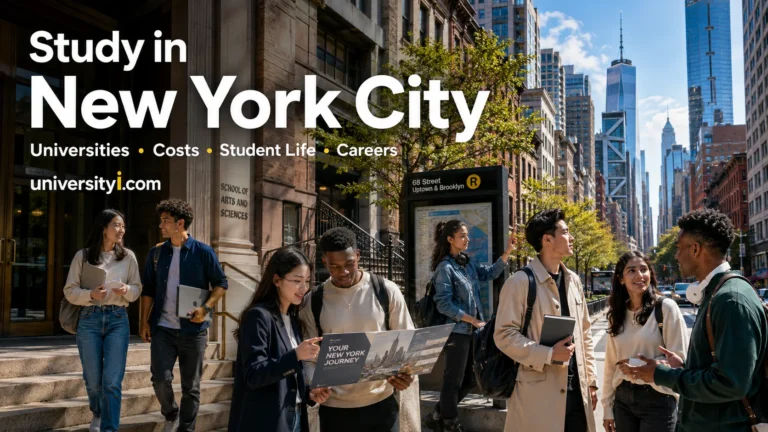
Columbia, NYU, CUNY, Tuition, Student Housing, Transport, Safety and Career Opportunities for International Students
Best Universities, Tuition, Student Housing, Transport, Careers and International Student Guide to New York City
New York City is not one university market. It is several education markets operating inside the same five-borough city — from public CUNY colleges with comparatively low tuition to private universities where the published annual cost of attendance can approach or exceed $100,000 before financial aid.
That price spread is the first fact international students should understand.
For 2026–2027, Columbia College lists $72,800 in tuition, $3,430 in mandatory fees and an estimated total cost of $99,044 plus travel. NYU’s College of Arts and Science lists $68,576 in tuition and fees and an estimated total cost of attendance of $100,998. By contrast, CUNY’s current four-year senior-college tuition is $6,930 per year for qualifying New York State residents, while nonresident undergraduates are generally charged $620 per credit. Cooper Union lists undergraduate tuition of $44,550 but automatically provides every admitted undergraduate a half-tuition scholarship worth $22,275 for 2026–2027.
That is New York’s defining advantage and its defining complication.
A student can study business at Baruch College, engineering at Columbia, technology at NYU Tandon or Cornell Tech, fashion at FIT or Parsons, architecture at Cooper Union or Pratt, performing arts at Juilliard or NYU Tisch, journalism at Columbia or CUNY, and medicine or biomedical science within one of the world’s densest academic and professional ecosystems.
But tuition is only part of the decision.
Housing can cost more than tuition at some public colleges. A long commute can turn a lower rent into a poor daily decision. A prestigious private university can be financially sensible after strong institutional aid, while a seemingly cheaper option can become expensive once housing and living costs are added.
For international students, New York City should therefore be judged on five variables together: university fit, net cost, housing location, transport and career access.
New York City in 60 seconds
| Question | Practical answer | Why it matters |
|---|---|---|
| Is NYC good for international students? | Yes, for students who value institutional choice, global networks and employer access | The city combines universities, industries and international communities at unusual scale |
| Is NYC expensive? | Yes | Housing is the biggest pressure point |
| Is every NYC university expensive? | No | CUNY creates a radically different public-cost model |
| Is Manhattan necessary? | No | Brooklyn, Queens and the Bronx can offer strong academic and housing alternatives |
The right question is not simply:
Should I study in New York City?
It is:
Which New York City education model gives me the strongest academic and career return for the total cost I will actually pay?
That is the decision this guide is built to answer.
1. Why Study in New York City in 2027?
New York City combines three assets that rarely exist at the same scale in one place:
universities, employers and global connectivity.
The city contains research universities, public colleges, specialist professional schools, arts institutions, medical and biomedical centers, technology programs and graduate-only research institutions.
CUNY alone now describes itself as one university with 26 colleges across all five boroughs, including 11 four-year colleges, seven two-year colleges and eight graduate and professional schools.
Private institutions add another academic layer.
Columbia University anchors Morningside Heights and parts of Upper Manhattan. New York University extends from Greenwich Village into Downtown Brooklyn. Fordham operates major campuses in the Bronx and Manhattan. The New School and Parsons occupy central Manhattan. Pratt’s principal campus sits in Brooklyn. St. John’s has its main New York campus in Queens. Cooper Union is based in the East Village.
Then there are highly specialized institutions.
FIT is deeply connected to fashion and design. Juilliard is focused on performing arts. Rockefeller University is a graduate-level biomedical research institution. Weill Cornell Medicine occupies a major role in medicine and biomedical science. Cornell Tech adds a graduate technology ecosystem on Roosevelt Island.
This breadth produces an unusual advantage:
Students do not have to choose between a global city and a specialized academic environment. They can often have both.
But breadth is not the same as fit.
A student interested in low-cost public business education should not evaluate New York through Columbia’s price structure.
A student pursuing experimental biomedical research should not evaluate the city primarily through CUNY tuition.
A design student may care more about Parsons, FIT, Pratt and Cooper Union than about general university rankings.
New York works best when the institution, subject and city ecosystem reinforce each other.
2. New York City Is Five Boroughs, Not One Campus
International students often imagine “studying in New York” as living in Manhattan and walking past skyscrapers on the way to class.
That is one version.
It is not the only one.
New York City consists of:
- Manhattan;
- Brooklyn;
- Queens;
- the Bronx;
- Staten Island.
The higher-education ecosystem crosses all five.
Manhattan has the greatest concentration of higher-education institutions. Brooklyn has major campuses and a large student rental market. Queens combines lower-cost residential areas with institutions such as St. John’s and Queens College. The Bronx includes Fordham’s Rose Hill campus and multiple CUNY institutions.
Geography changes the student experience.
A Columbia student living near Morningside Heights may spend much of the week in Upper Manhattan.
An NYU student at Washington Square lives inside one of the densest downtown neighborhoods in the United States.
An NYU Tandon student can study in Downtown Brooklyn rather than Greenwich Village.
A St. John’s student may build daily life around Queens rather than Manhattan.
A Fordham student at Rose Hill has a different commute and residential environment from a Fordham student at Lincoln Center.
This matters because New York City is too large to treat distance casually.
A campus and an apartment can both have “New York, NY” addresses while still producing a difficult daily commute.
Choose the campus first.
Then choose the neighborhood.
3. Best Universities and Colleges in New York City: Start With Fit, Not One Ranking
There is no single defensible list of the “best universities in New York City” for every student.
Rankings measure different things. Undergraduate teaching, research intensity, employability, subject reputation, affordability and specialist excellence do not produce the same order.
A stronger way to compare NYC universities is by academic role.
| Student priority | Institutions to investigate first | Why |
|---|---|---|
| Research-intensive global university | Columbia, NYU | Broad research depth and global networks |
| Public-value route | CUNY colleges | Much lower published tuition |
| Art, fashion and design | Parsons, FIT, Pratt, Cooper Union | Specialist academic ecosystems |
| Technology and engineering | Columbia, NYU Tandon, Cooper Union, City College, Cornell Tech | Strong technical pathways |
Columbia University
Columbia is a private research university centered in Morningside Heights, with major academic and professional activity elsewhere in Manhattan.
Its academic strengths span arts and sciences, engineering, business, law, journalism, international affairs, medicine and research.
For international students, Columbia’s attraction is not merely the Ivy League label.
The larger proposition is research depth + Manhattan access + powerful graduate/professional ecosystems.
The trade-off is cost.
The 2026–2027 Columbia College estimate lists $72,800 tuition and approximately $99,044 total cost before travel.
New York University
NYU is geographically different.
It is deeply integrated into the city, with Washington Square at the center of its Manhattan identity and major academic activity in Brooklyn, including NYU Tandon.
NYU’s subject reach includes business, law, arts, film, technology, engineering, data science, social sciences, health and professional programs.
For many international students, NYU’s strongest advantage is this:
the university is not beside New York City; it is embedded inside it.
That gives access.
It also means there is less separation between “campus” and “city.”
For 2026–2027, NYU’s College of Arts and Science lists tuition and fees of $68,576 and estimated total attendance cost of $100,998. Stern’s published tuition-and-fee amount is higher, and Tisch’s is higher again, demonstrating why students must check the actual NYU school rather than quoting one university-wide tuition figure.
City University of New York
CUNY is the other side of the NYC education equation.
It is a public university system with 26 colleges across five boroughs. Its current structure includes 11 four-year colleges, seven two-year colleges and eight graduate or professional schools.
For international students, CUNY’s attraction is not that every campus is equivalent.
They are not.
The opportunity lies in matching a specific college to a specific subject at a radically different tuition level from many private institutions.
Baruch is important for business and accounting.
City College has strengths in engineering, architecture and sciences.
Hunter is strong across arts and sciences, health and education.
Queens College and Brooklyn College offer broad undergraduate and graduate portfolios.
The public-cost structure can fundamentally change the affordability calculation.
Cooper Union
Cooper Union is small, specialist and academically distinctive.
It focuses on architecture, art and engineering.
The financial model is also unusual.
For 2026–2027, undergraduate tuition is $44,550, but every admitted undergraduate receives a half-tuition scholarship worth $22,275. Students may receive additional aid depending on eligibility and circumstances.
That is materially different from the outdated claim that every Cooper Union student automatically receives full tuition.
Specialist institutions
New York’s strength is especially visible when students stop looking only at general universities.
Parsons and FIT matter in fashion and design.
Pratt matters in architecture, art and design.
Juilliard matters in music, dance and drama.
Rockefeller matters in biomedical research.
Weill Cornell matters in medicine.
A serious New York university search should therefore begin with:
What do I want to study?
Then ask:
Which institution is strongest for that particular decision?
4. Columbia vs NYU vs CUNY: Three Different Ways to Study in New York
For international students, Columbia, NYU and CUNY illustrate three distinct education models.
Columbia: concentrated elite research ecosystem
Columbia offers a more recognizable campus environment than many central-Manhattan institutions.
Morningside Heights creates a defined academic district.
Students who value:
- intensive research;
- a traditional university setting;
- strong graduate and professional schools;
- institutional prestige;
- academic depth;
may find the model attractive.
The financial barrier is substantial unless aid materially reduces the cost.
NYU: city-integrated global university
NYU is built around urban integration.
The campus is dispersed through the city rather than contained behind one dominant gate.
Students who value:
- downtown city life;
- professional access;
- arts and media;
- business and technology;
- a highly international student environment;
may prefer this model.
The trade-off is that New York itself becomes part of the operational cost of attending NYU.
CUNY: public access across the city
CUNY offers a completely different financial proposition.
Its senior-college tuition for New York State residents is $3,465 per semester, or $6,930 per academic year. Nonresident undergraduates at four-year colleges are generally charged $620 per credit; at 15 credits per semester that is approximately $18,600 for the year.
International students will normally need to evaluate themselves under the applicable nonresident tuition rules unless they independently satisfy a resident-tuition exception.
The key insight is striking:
At CUNY, housing can easily become a larger financial problem than tuition.
That changes how affordability should be analyzed.
5. Best Universities in NYC by Subject
New York’s academic power becomes clearer when viewed by field.
Business and finance
New York is one of the world’s dominant finance centers.
That makes programs at:
- NYU Stern;
- Columbia Business School;
- Baruch College’s Zicklin School;
- Fordham’s Gabelli School;
- Pace’s Lubin School;
particularly relevant to students who want proximity to finance, consulting, accounting and corporate employers.
Baruch deserves special attention for value-focused students because it places a public CUNY institution inside the Manhattan business ecosystem.
Computer science, technology and engineering
Students should investigate:
- Columbia Engineering;
- NYU Tandon;
- NYU Courant and data/AI programs;
- Cooper Union;
- City College’s Grove School of Engineering;
- Cornell Tech.
New York is not Silicon Valley.
It does not need to be.
The city has developed a substantial technology economy while retaining extraordinary strength in finance, media, advertising, healthcare and professional services — industries that increasingly employ technical graduates.
Arts, design and fashion
Few cities offer a comparable academic concentration.
Important institutions include:
- Parsons;
- FIT;
- Pratt;
- Cooper Union;
- School of Visual Arts;
- NYU Tisch;
- Juilliard.
For these students, the city itself becomes part of the educational infrastructure.
Museums, galleries, fashion businesses, performance venues, design firms and media organizations can extend learning beyond the classroom.
Journalism and media
New York remains one of the world’s most consequential media cities.
Columbia Journalism School, NYU’s journalism programs and the Craig Newmark Graduate School of Journalism at CUNY sit inside an environment containing major publishers, broadcasters, digital media operations and news organizations.
That proximity does not guarantee internships.
It improves access to the ecosystem where those opportunities exist.
Medicine, health and biomedical sciences
The city’s institutions include Columbia’s medical and health-science ecosystem, NYU Langone and NYU Grossman, Weill Cornell Medicine, Rockefeller University, Mount Sinai and CUNY health programs.
Healthcare is also one of New York’s largest employment sectors.
For international students, however, medical and regulated health careers require separate attention to licensing, clinical requirements and immigration rules.
A degree alone is not permission to practise.
6. New York City University Admissions for International Students
There is no “New York City admission system.”
Each institution controls its own academic admissions process.
CUNY has a centralized application structure for many undergraduate programs, while private universities operate their own institutional or Common Application processes.
International applicants should expect to manage some combination of:
- academic transcripts;
- certified translations where required;
- English-language evidence;
- essays;
- recommendations;
- standardized testing where applicable;
- portfolios or auditions for specialist programs;
- financial documentation for visa purposes.
The key 2027 rule is simple:
Do not transfer last year’s deadline into this year’s application.
Universities can change:
- Early Decision dates;
- Regular Decision dates;
- test policies;
- English-language requirements;
- portfolio requirements;
- application fees.
CUNY’s current official admissions materials show applications for Fall 2026 and Spring 2027 and state that CUNY’s undergraduate admissions policy is test-optional through Spring 2027.
That should not be generalized to Columbia, NYU, Fordham, Parsons or other institutions.
Each applicant should build a university-specific deadline sheet.
In New York, the number of options creates opportunity.
It also creates administrative complexity.
7. Tuition Fees in New York City: The Numbers Can Differ by More Than $60,000
The phrase “New York university tuition” is almost meaningless without an institution name.
Consider the 2026–2027 evidence.
| Institution/model | Published tuition signal | Important qualification |
|---|---|---|
| Columbia College | $72,800 | Mandatory fees and living costs are additional |
| NYU CAS | $68,576 tuition + fees | Other NYU schools can charge more |
| CUNY senior college | $6,930 NYS resident | Nonresidents generally $620/credit |
| Cooper Union | $44,550 gross tuition | Every admitted undergraduate gets $22,275 half-tuition scholarship |
The lesson is not simply that public universities are cheaper.
The deeper lesson is:
Published tuition is not net price.
A high-price private university may provide substantial need-based aid.
A public university may offer far less institutional aid to an international student but begin at a much lower published tuition.
The correct comparison is:
tuition + mandatory fees + housing + food + insurance + transport + personal expenses − confirmed aid
Anything else is incomplete.
8. Cost of Attendance: Why a $70,000 Tuition Bill Can Become a $100,000 Year
Columbia’s 2026–2027 College estimate illustrates the difference between tuition and total cost.
It lists:
- tuition: $72,800;
- mandatory fees: $3,430;
- average room and board: $19,650;
- books and personal expenses: $3,164;
- total: $99,044 plus travel.
NYU’s College of Arts and Science lists:
- tuition and fees: $68,576;
- food and housing: $26,438;
- books and supplies: $1,492;
- transportation: $2,438;
- personal expenses: $2,054;
- total: $100,998.
These budgets are not promises of what every student will spend.
They are planning frameworks.
A student living cheaply with roommates may spend less.
A student renting alone in Manhattan may spend more.
That is why cost of attendance is useful:
it reveals the scale of the full decision.
Do not use tuition alone to compare New York universities.
9. Scholarships and Financial Aid for International Students
New York City’s high published prices make financial aid decisive.
But international-student aid policies vary substantially.
Some private universities offer institutional need-based aid to international applicants.
Some operate need-aware admissions for non-U.S. citizens, meaning the applicant’s financial need can be considered during admission.
Some provide merit scholarships.
Some offer very little undergraduate aid.
Graduate funding is even more program-specific.
PhD programs may provide tuition support and stipends, while many master’s programs expect students to finance a substantial share of the cost.
Cooper Union’s unusual model
Cooper Union provides one of the clearest examples of why students should read the current aid policy rather than rely on reputation.
Every admitted undergraduate receives a half-tuition scholarship worth $22,275 per year against 2026–2027 tuition of $44,550.
That is significant.
It is not the same as automatic full tuition.
NYU’s published financial-aid framework
NYU states that for first-time, first-year undergraduate students admitted to its New York campus, it will meet 100% of demonstrated need under its NYU Promise framework and that families with income below $100,000 and typical assets will not have to pay tuition. Eligibility and the treatment of individual international applicants should be confirmed through NYU’s current aid rules rather than assumed from the headline alone.
The practical aid rule
Never compare scholarships by headline.
Compare:
award amount + renewal rules + eligibility + net annual cost + four-year cost
A $20,000 scholarship at a $90,000 institution may still leave a larger bill than no scholarship at a lower-cost public university.
10. Student Housing in New York City: The Largest Financial Risk
For many international students, housing is the hardest part of New York.
Tuition is published.
Private rent moves.
A university can tell you the price of a residence hall.
The private market depends on:
- borough;
- neighborhood;
- apartment size;
- building quality;
- roommates;
- amenities;
- lease date;
- market conditions.
2026 housing data shows broad one-bedroom median asking-rent signals around $4,400 in Manhattan, $3,450 in Brooklyn, $2,750 in Queens and $2,100 in the Bronx, while student-relevant neighborhoods vary substantially.
These are market indicators.
They are not what every student pays.
International students should generally evaluate three housing models:
University housing
Advantages:
- easier arrival;
- furniture included;
- simpler billing;
- campus proximity;
- fewer landlord-screening problems.
Trade-off:
- not always cheap;
- limited availability;
- academic-year restrictions.
Shared private housing
Advantages:
- can materially reduce per-person rent;
- greater independence;
- more neighborhood choice.
Trade-off:
- deposits;
- roommate risk;
- utilities;
- lease obligations;
- commuting.
Private studio or one-bedroom
Advantages:
- privacy;
- independence.
Trade-off:
- extremely high cost in many central neighborhoods.
The strongest NYC budget lever is usually not cutting coffee.
It is sharing housing intelligently.
11. Manhattan vs Brooklyn vs Queens vs the Bronx for Students
The borough decision can change both cost and quality of life.
Manhattan
Best for:
- proximity to Columbia, NYU, The New School, Parsons, FIT, Cooper Union and many professional schools;
- internships in central business districts;
- cultural access;
- shortest commutes for many Manhattan campuses.
Main disadvantage:
price.
A student paying a premium simply to say “I live in Manhattan” may be buying little academic value.
Brooklyn
Brooklyn offers a strong mix of universities, creative industries and residential neighborhoods.
It is especially relevant to:
- NYU Tandon;
- Pratt;
- Brooklyn College;
- students commuting to Lower Manhattan.
Some areas are now extremely expensive.
Others still offer better shared-housing economics than prime Manhattan.
Queens
Queens deserves more attention from cost-conscious international students.
It is geographically large and highly diverse.
Queens College and St. John’s are major academic anchors.
Neighborhoods such as Astoria, Flushing and parts of western Queens can offer different rent/commute combinations.
Long Island City is extremely convenient to Midtown but increasingly expensive.
The Bronx
The Bronx can offer lower housing costs and is directly relevant to Fordham’s Rose Hill campus and several CUNY institutions.
Students should evaluate exact transit access rather than borough reputation.
A low-rent apartment with a difficult commute is not automatically better value.
12. Best Neighborhoods for Students in New York City
There is no universally best student neighborhood.
There is only the best neighborhood for your campus, budget and daily routine.
Morningside Heights
Best aligned with Columbia and Barnard.
Strengths:
- walkability to campus;
- academic atmosphere;
- university services;
- direct subway access.
Trade-off:
housing remains expensive.
Washington Heights
Relevant to Columbia’s Upper Manhattan ecosystem and students looking for potentially lower rent than central Manhattan.
The area is highly connected by subway but requires exact address-level commute analysis.
Greenwich Village
The iconic NYU environment.
It is academically convenient and culturally powerful.
It is also among the least budget-friendly student choices.
East Village
Popular with students seeking nightlife, restaurants and proximity to downtown campuses.
Price and noise are the obvious trade-offs.
Downtown Brooklyn
Highly relevant to NYU Tandon and students who want excellent subway connectivity.
New development has increased housing quality — and cost.
Bushwick
Can be useful for students who prioritize shared housing and Brooklyn access.
Commute quality depends heavily on the exact subway line.
Astoria
Popular for food, community and relatively convenient access to Manhattan.
It can work particularly well for students whose campuses align with western Queens transit.
Flushing
Important for Queens College and students who value one of the city’s most internationally diverse commercial districts.
The trade-off is distance from many Manhattan campuses.
The University Intelligence neighborhood rule
Do not choose by borough.
Choose by:
door-to-door commute + total rent + transit reliability + everyday services + campus fit.
13. How Much Does It Cost to Live in New York City as a Student?
There is no honest single answer.
A shared apartment in an outer-borough neighborhood and a private Manhattan studio can produce radically different budgets.
A useful planning framework is:
| Student model | Housing strategy | Likely cost pressure |
|---|---|---|
| Cost-controlled | Shared apartment, lower-cost neighborhood | Housing still dominant |
| Moderate | Campus/shared near university | Higher rent, easier commute |
| High-cost | Private studio/1BR in central area | Very high housing burden |
The most important planning categories are:
- rent;
- food;
- local transportation;
- utilities;
- phone/internet;
- health insurance;
- books;
- personal expenses;
- emergency reserve.
Students should also distinguish between a nine-month university budget and a twelve-month lease.
That difference can add three months of rent.
In New York, three months is not a rounding error.
14. NYC Subway, OMNY and Student Transportation
New York City’s transit system is one of its greatest student advantages.
A student does not need a car to access most major campuses and employment districts.
Under the 2026 MTA fare structure, the subway and local-bus base fare is $3.00, while the OMNY weekly fare cap is $35 when qualifying rides are paid with the same payment method. Express-bus fares and commuter rail are higher.
That matters because a predictable transit system can expand a student’s housing search.
A student studying in Manhattan can live in Brooklyn, Queens or the Bronx and still maintain practical access to campus.
But transit geography is not symmetrical.
Living near a subway station does not automatically mean a fast commute to every university.
Transfers matter.
Line reliability matters.
Late-night frequency matters.
The correct housing question is:
How many reliable transfers stand between my front door and my classroom?
A twenty-minute direct subway ride can be better than a twelve-minute trip requiring an awkward transfer.
15. Do College Students Get an MTA Discount?
New York does not provide one universal university-student subway discount simply because a rider attends college.
Specific programs can exist for eligible groups, and New York City’s Fair Fares program provides reduced fares to qualifying low-income city residents.
International students should not automatically budget on the assumption that their university ID cuts the subway fare.
The safer baseline is the ordinary MTA fare.
If the university or another eligibility program gives a discount, treat that as a saving.
Not as the starting assumption.
16. Healthcare and Student Health Insurance
Healthcare is another cost international students often underestimate.
Universities may require students to carry qualifying insurance or automatically enroll them in a university-sponsored health plan unless a waiver is approved.
The exact rules differ by institution and degree level.
NYU’s 2026–2027 cost-of-attendance material explicitly states that health insurance is not included in its standard undergraduate cost-of-attendance figure, and that students without sufficient existing coverage may initially be enrolled in a university-sponsored plan.
Columbia’s health charges likewise vary by school and level.
For example, Columbia GSAS lists a 2026–2027 student health-insurance premium of $5,823 plus a separate health-services fee for relevant graduate students.
Do not transfer that graduate figure to every Columbia undergraduate.
The correct budgeting process is:
- identify the university’s required plan;
- determine whether your existing insurance qualifies for waiver;
- add the current premium if it does not;
- understand deductibles and out-of-pocket costs.
Insurance is not optional budgeting simply because the student is young.
17. Is New York City Safe for International Students?
New York City should not be described as simply “safe” or “unsafe.”
It is a city of more than eight million people with meaningful variation by location, time, transit pattern and type of crime.
Official NYPD evidence in the research base shows 305 murders citywide in 2025, down substantially from 2024, while major crime also declined across important 2026 reporting periods.
That does not eliminate risk.
It does provide context.
Students should think about safety operationally:
- how late classes end;
- whether the subway route is direct;
- the walk from the station to housing;
- university escort or shuttle services;
- building access;
- nighttime activity on the block;
- emergency communication.
The wrong way to evaluate safety is:
“Is Brooklyn safe?”
Brooklyn is enormous.
The better question is:
“What does my actual route from this building to this campus look like at the hours I will use it?”
That is decision-quality safety analysis.
18. International Student Life in New York City
For international students, New York offers an unusual advantage: being international is normal.
NYU and Columbia both host very large international communities, although institutional and Open Doors counts use different definitions and can include different combinations of enrolled students, scholars and students in practical training. The important conclusion is robust even where the exact definitions differ: both universities operate at major international scale.
The city itself is also globally diverse.
That affects daily life.
Students can find:
- food from almost every major world region;
- cultural organizations;
- religious communities;
- multilingual services;
- international professional networks;
- global airports;
- visiting academics and executives;
- diaspora communities.
This reduces one kind of international-student friction.
It does not eliminate homesickness, cultural adjustment or financial pressure.
New York can be simultaneously familiar and overwhelming.
Its diversity makes entry easier.
Its intensity can make daily life harder.
19. Frequently Asked Questions About Studying in New York City
1. Is New York City a good place for international students?
Yes, particularly for students who value university choice, global networks, internships, culture and public transportation. The main disadvantages are housing cost, high private-university prices and an intense urban environment. The decision is strongest when the academic program and career ecosystem justify the total cost.
2. What are the best universities in New York City?
Columbia and NYU are the city’s major broad research universities, but the strongest institution depends on subject and budget. CUNY offers public options, while Parsons, FIT, Pratt, Cooper Union, Juilliard, Rockefeller and other specialist institutions can be stronger choices for particular disciplines.
3. Is Columbia University in New York City?
Yes. Columbia’s main Morningside Heights campus is in Manhattan, with other major university facilities elsewhere in New York City.
4. Is NYU in Manhattan?
NYU’s principal Washington Square academic environment is in Manhattan, but the university also has major operations in Brooklyn, including NYU Tandon School of Engineering.
5. How many colleges does CUNY have?
CUNY currently describes itself as one university with 26 colleges: 11 four-year colleges, seven two-year colleges and eight graduate and professional schools.
6. Is CUNY cheaper for international students?
CUNY’s published tuition is much lower than many private NYC universities. Nonresident undergraduates at senior colleges are generally charged $620 per credit, while eligible New York State residents pay $6,930 annually for full-time undergraduate tuition. International students must check the residency rules applicable to their own case.
7. How much is Columbia tuition for 2026–2027?
Columbia College lists undergraduate tuition of $72,800 for 2026–2027. Mandatory fees, housing, food and other expenses bring the published estimated total to $99,044 plus travel.
8. How much does NYU cost in 2026–2027?
NYU’s College of Arts and Science lists $68,576 in tuition and fees and a total estimated cost of attendance of $100,998 for 2026–2027. Some NYU schools, including Stern and Tisch, have higher tuition figures.
9. Is Cooper Union free?
No. For 2026–2027, Cooper Union lists undergraduate tuition of $44,550. Every admitted undergraduate receives a half-tuition scholarship worth $22,275, with additional aid potentially available.
10. Is living in New York more expensive than tuition?
At some public colleges, yes. For a CUNY international/nonresident student, annual private housing can potentially exceed tuition. At expensive private universities, tuition remains a major component, but housing still adds tens of thousands of dollars.
11. How much is a one-bedroom apartment in Manhattan?
2026 rental data places the broad Manhattan one-bedroom median asking-rent signal around the mid-$4,000s per month, although neighborhood, building type and methodology can change the figure materially.
12. Is Brooklyn cheaper than Manhattan for students?
Often, but not always. Premium Brooklyn neighborhoods can be extremely expensive. Shared apartments farther from the highest-cost districts may provide better value, especially when the commute remains direct.
13. Is Queens good for international students?
Yes. Queens combines major universities, diverse immigrant communities and housing options that can be less expensive than central Manhattan. The strongest choice depends on campus location and subway access.
14. Is the Bronx a good place for students?
It can be, particularly for Fordham Rose Hill and CUNY students. Some areas offer lower rent than Manhattan. Students should assess exact neighborhood and transit conditions rather than judging the entire borough as one market.
15. Do I need a car to study in New York City?
Usually not. The subway, buses and commuter rail make car-free student life practical for most major campuses. A car can create additional costs for parking, insurance and congestion.
16. How much is the NYC subway fare?
The MTA base fare for subway and local bus service is $3.00 under the 2026 fare structure.
17. What is the OMNY weekly fare cap?
The 2026 MTA fare structure sets the ordinary subway/local-bus OMNY weekly cap at $35 when qualifying trips use the same payment method.
18. Do university students get free subway travel?
There is no universal MTA program making subway travel free for every university student. Eligibility-based programs may reduce fares for specific riders.
19. Is student health insurance expensive in New York?
It can add several thousand dollars per year. The exact premium depends on the institution and coverage level. Students should verify whether their existing insurance qualifies for a waiver before budgeting.
20. Are there scholarships for international students in NYC?
Yes, but policies differ sharply. Some private universities offer institutional need-based aid, some provide merit scholarships, and graduate programs may offer assistantships or doctoral funding. International applicants should verify each award directly rather than assuming U.S. federal aid is available.
21. Can international students work while studying in NYC?
F-1 employment authorization is governed by federal law, not New York City. On-campus employment, CPT, OPT and STEM OPT have separate rules. A job opportunity in NYC does not itself create legal permission to work.
22. Is New York City good for internships?
New York has exceptional employer density across finance, media, technology, advertising, fashion, healthcare, law and professional services. That creates opportunity, but internships remain competitive and international students must separately satisfy work-authorization rules.
23. Is NYC good for technology students?
Yes. NYU Tandon, Columbia, Cornell Tech, Cooper Union and CUNY engineering/computing programs sit inside a large technology and professional-services economy. New York also creates cross-industry technology opportunities in finance, media, healthcare and advertising.
24. Is NYC good for business students?
Yes. New York’s finance, consulting, accounting, corporate, advertising and startup sectors create a deep business ecosystem. NYU Stern, Columbia, Baruch, Fordham and Pace are among the institutions relevant to business students.
25. Is NYC good for arts and design students?
It is one of the strongest city ecosystems for art, fashion, design, film and performing arts because academic institutions operate alongside museums, galleries, fashion businesses, theatres, publishers and media companies.
26. Is New York safe for students?
Safety depends on the specific area, route and time. Citywide crime data should provide context, but students should evaluate the exact commute between housing and campus and use university security resources where available.
27. What is the cheapest way to study in NYC?
A cost-focused strategy usually combines a lower-tuition institution such as CUNY with shared housing and a direct public-transit commute. The lowest tuition does not automatically produce the lowest total cost if housing is poorly planned.
28. Should I live in Manhattan if my university is there?
Not necessarily. Students can often reduce housing costs by living in another borough, provided the commute remains reliable. Calculate monthly savings against travel time and quality of life.
29. Can I stay in New York after graduation?
International students need a lawful federal immigration pathway. Depending on eligibility, F-1 graduates may use OPT and qualifying STEM graduates may seek a STEM OPT extension. Longer-term employment requires a separate lawful status or immigration route.
30. Is studying in New York City worth the cost?
It can be when the university, program, aid package and employer access produce enough value to justify the total expense. It is a weaker decision when a student pays a large premium for the city without gaining corresponding academic or career advantages.
20. Careers and Internships: Why New York’s Employer Density Matters
New York’s career value is not that every student gets an internship.
It is that an unusually large number of industries operate at scale within the same metropolitan economy.
Major employment ecosystems include:
- finance and insurance;
- healthcare;
- professional services;
- technology;
- media;
- advertising;
- law;
- fashion;
- design;
- publishing;
- entertainment;
- nonprofit organizations;
- research.
That produces a distinctive cross-industry advantage.
A software graduate does not have to work only for a technology company.
Banks hire software engineers.
Media companies hire data professionals.
Hospitals hire analysts and technology specialists.
Fashion businesses hire marketers, supply-chain professionals and digital designers.
The career ecosystem is interconnected.
The important limit
Employer density is not job security.
New York is also one of the most competitive graduate markets in the country.
The city rewards students who arrive with:
- strong skills;
- internships;
- portfolios;
- research;
- networks;
- professional communication;
- clear work authorization.
Location creates access.
Students still have to convert access into employment.
21. CPT, OPT and STEM OPT in New York City
New York City does not issue work authorization to F-1 students.
Federal rules control.
That means the basic career structure is the same whether the student studies in Manhattan, Boston or California.
Eligible F-1 students may use:
CPT for qualifying curricular practical training;
OPT for up to 12 months of degree-related practical training;
and, for eligible graduates with qualifying STEM degrees and employers, a 24-month STEM OPT extension.
The city-specific advantage lies in employer access.
The immigration rules remain federal.
International students should therefore separate two questions:
Can I find an employer in New York?
and
Am I legally authorized to work for that employer?
A yes to the first does not answer the second.
For detailed current F-1 employment rules, readers should use the dedicated University Intelligence career and student-visa guides rather than treating a city destination page as an immigration manual.
22. The 2026–2027 F-1 Change International Students Must Watch
A major federal change makes the 2027 study cycle unusually important.
On July 17, 2026, the U.S. Department of Homeland Security published a final rule changing F, J and I admission from the traditional Duration of Status model to fixed admission periods.
The rule states that it is a major rule subject to congressional review. Its published effective-date mechanism is 60 days after Federal Register publication, with DHS required to publish a further notice if congressional review changes the date or terminates the rule.
This matters for New York students because the city’s universities host large international populations.
But the rule is federal.
It is not a special New York policy.
International applicants should therefore verify the status of the rule immediately before:
- travel;
- visa issuance;
- entry;
- program extension;
- OPT filing;
- post-completion planning.
This page should not replace the detailed visa guide.
Its purpose is to flag the decision risk:
2027 F-1 timing should not be calculated from an old D/S-era article without checking the rule actually in force.
23. Student Life: New York’s Greatest Non-Academic Advantage
New York’s student experience extends far beyond a campus.
The city contains three independent public-library systems:
- New York Public Library;
- Brooklyn Public Library;
- Queens Public Library.
Its cultural infrastructure includes major museums, performing-arts institutions, galleries, music venues and public parks.
Central Park covers 843 acres.
Prospect Park covers 526 acres.
Flushing Meadows Corona Park covers approximately 870.76 acres in the current official property record used in the evidence reconciliation.
The value of these places is not simply tourism.
For students, they can become:
- study spaces;
- research resources;
- cultural education;
- exercise;
- social environments;
- low-cost recreation.
New York is expensive.
Some of its strongest student assets are free.
That is an important counterweight to the cost narrative.
24. Advantages and Disadvantages of Studying in New York City
Major advantages
Extraordinary university choice
Students can move from global research universities to public colleges to specialist institutions without leaving the city.
Career density
Finance, technology, healthcare, media, law, fashion, advertising, research and professional services operate at scale.
Public transportation
The subway makes it possible to live in one borough and study in another without owning a car.
International environment
New York’s global population and major international university communities can reduce cultural isolation.
Subject-specific ecosystems
Fashion students can study inside the fashion industry.
Finance students study beside one of the world’s dominant financial centers.
Journalism students study inside a major global media market.
That alignment can matter.
Major disadvantages
Housing cost
This is the biggest structural weakness.
Private-university cost
Published annual costs at Columbia and NYU can approach or exceed $100,000 before aid.
Competition
The same city that creates opportunity attracts highly qualified students and professionals from around the world.
Urban intensity
Crowds, noise, small living spaces and fast daily routines are not ideal for everyone.
Commute risk
Bad housing geography can turn a prestigious university experience into hours of weekly travel.
The correct decision must weigh both sides.
25. Who Should Choose New York City — and Who Should Not?
New York City is especially strong for students who want:
- urban life;
- internships;
- professional networking;
- specialized academic ecosystems;
- public transportation;
- international diversity;
- exposure to multiple industries.
It may be less suitable for students who strongly prefer:
- a quiet residential campus;
- low housing costs;
- large personal living space;
- minimal commuting;
- a slower daily pace.
The city should not be chosen because it is famous.
It should be chosen because the student’s academic subject and career plan gain something specific from being there.
A finance student at Baruch has a clear city rationale.
A journalism student at Columbia or CUNY has one.
A fashion student at FIT or Parsons has one.
A technology graduate building a career across finance, media and startups can have one.
If the student cannot explain what New York adds to the degree, paying the New York premium becomes harder to justify.
26. New York City Student Decision Checklist
Before accepting an offer, answer these questions in writing.
University
Is this the strongest program among the offers I can realistically afford?
Net cost
What will I pay after confirmed scholarships and aid?
Total annual cost
Have I included:
- tuition;
- fees;
- housing;
- food;
- health insurance;
- transportation;
- books;
- personal expenses?
Housing
Where would I actually live?
Not:
“somewhere in Brooklyn.”
An actual neighborhood.
An actual commute.
An actual rent assumption.
Career
What industries hire graduates from this program?
Does the university have:
- career services;
- internship access;
- alumni networks;
- employer relationships;
- relevant New York location advantages?
Immigration
If you are an international student:
- what is the visa requirement;
- what work authorization may be available;
- does the degree qualify for STEM OPT if that matters;
- what federal rules apply to your 2027 timeline?
Risk
How much financial reserve remains after the first-year budget?
A plan that uses every available dollar before classes begin is fragile.
New York rewards ambition.
It punishes weak budgeting.
27. University Intelligence Verdict: Is New York City Worth It for International Students?
New York City can be one of the strongest places in the world to study.
It can also be one of the most expensive places to make a poorly planned education decision.
Both statements are true.
The city’s power comes from combination.
Columbia and NYU provide globally connected private-research environments. CUNY creates a dramatically different public-cost pathway across 26 colleges. Specialist institutions connect students directly to fashion, art, architecture, performing arts, medicine, research and technology. Public transit links those institutions to an enormous employer economy.
The cost gap is equally dramatic.
For 2026–2027, Columbia College’s published total estimate is about $99,044 plus travel. NYU CAS lists $100,998. CUNY’s four-year resident undergraduate tuition remains $6,930 annually, while nonresident tuition is generally $620 per credit. Cooper Union automatically cuts its $44,550 published tuition in half for every admitted undergraduate through a $22,275 scholarship.
That range explains New York better than any single ranking.
There is no one “New York City education.”
There are multiple routes.
The strongest route is the one where:
the program is strong, the net price is survivable, the housing is practical, the commute is controlled and the city’s employer ecosystem is genuinely relevant to the student’s future.
Do not pay for New York simply to live in New York.
Pay for access you can actually use.
That is when the city becomes more than an expensive location.
It becomes an educational advantage.