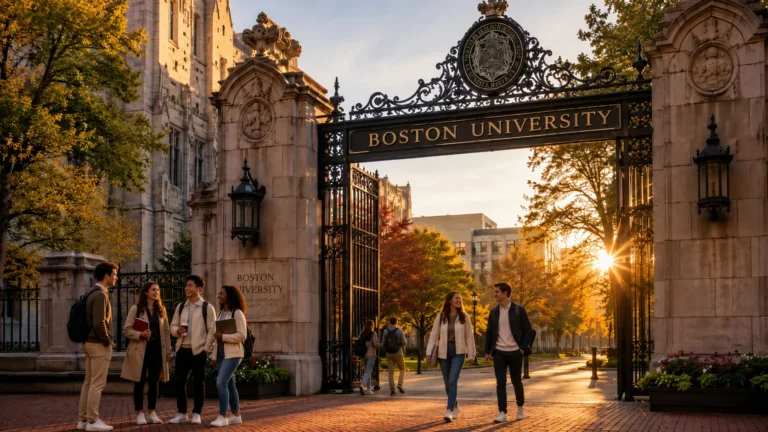
Boston University: Acceptance Rate, Tuition, Rankings & International Student Guide
Boston University offers a combination that relatively few American universities can match: the scale and research power of a major private university, a broad portfolio of undergraduate and professional programs, and a campus embedded directly inside one of the world’s strongest higher-education, healthcare, technology and research cities.
That opportunity comes at a formidable price.
For the 2026–2027 academic year, Boston University undergraduate tuition is $73,024. Its published residential undergraduate cost of attendance is approximately $98,419, while the international undergraduate financial estimate identified in BU’s international-student documentation reaches approximately $105,666 for a nine-month academic period.
Admission is also increasingly competitive. Boston University received approximately 76,779 applications for the Class of 2029, according to the current published information, with an overall acceptance rate of about 12.8%. The previous admission cycle was even more selective, at about 11.1%.
For 2027 applicants, one important issue is already settled: Boston University remains test optional through Fall 2028 and Spring 2029 entry. Students applying for 2027 admission can therefore decide whether SAT or ACT scores strengthen their application.
Academically, BU is much more than a university with a strong overall reputation. It has visible strengths across public health, economics, biomedical engineering, communication and media, business, law, computing and data science, medicine and other professional fields. Its location also gives students proximity to Boston and Cambridge’s biotechnology firms, hospitals, research institutes, financial companies, consulting firms, technology employers and media organizations.
For international students, however, Boston University requires particularly careful financial planning. International undergraduates can compete for major merit awards—including the prestigious Trustee Scholarship and Presidential Scholarship—but they should not assume that BU’s domestic need-based financial-aid policies apply to them.
The right way to evaluate Boston University is therefore not to ask only:
“Is Boston University a good university?”
It clearly is.
The more useful questions are:
Can you get in? Can you afford it? Does BU have the right academic strength for your subject? And can you convert Boston University’s location, research infrastructure and employer ecosystem into enough long-term value to justify the total cost?
Boston University 2027 — Quick Answer
| Measure | Boston University |
| Location | Boston, Massachusetts, United States |
| Institution type | Private nonprofit research university |
| Founded | 1839; chartered as Boston University in 1869 |
| Major campus | Charles River Campus |
| Students | More than 36,000 in recent institutional data |
| Schools and colleges | 17 major schools and colleges |
| 2026–27 undergraduate tuition | $73,024 |
| Official residential undergraduate COA | About $98,419 |
| International planning estimate | About $105,666 for the cited nine-month period |
| QS World University Rankings 2027 | #94 |
| THE World University Rankings 2026 | #76 |
| U.S. national position in cited research | About #42 |
| Recent first-year acceptance rate | About 12.8% for the Class of 2029 |
| Test policy for 2027 | Test optional |
| Major merit scholarships | Trustee Scholarship; Presidential Scholarship |
| Major academic strengths | Business, engineering, computing, communication, public health, medicine, economics, law |
Is Boston University worth it in 2027?
Boston University can be an excellent choice for students who want a large research university in a major global city and intend to use that location aggressively.
The university is especially compelling for students interested in fields where Boston itself becomes part of the educational advantage: biotechnology, healthcare, medicine, public health, engineering, computing, finance, consulting, communications, media and research.
But BU is not automatically a good financial decision for every admitted student.
An international undergraduate paying close to the full published cost could be committing more than $100,000 for a single academic year once tuition, housing, insurance and living expenses are considered. Over a four-year degree, changes in tuition and living costs can make the total commitment substantially larger.
Therefore, the University Intelligence view is straightforward:
Boston University is most valuable when a student has a strong academic fit, a realistic financing plan and a clear strategy for using BU’s research, internships, Boston location and professional network.
Prestige without that strategy is not enough.
1. What Is Boston University?
Boston University—commonly called BU—is a private nonprofit research university headquartered in Boston, Massachusetts.
Its institutional history reaches back to the Newbury Biblical Institute, founded in 1839. Boston University was formally chartered in Massachusetts under its current name in 1869.
The university has historical Methodist roots but operates today as a non-sectarian institution.
Over time, BU evolved from a collection of theological and professional schools into a large comprehensive research university. Its modern academic portfolio spans undergraduate liberal arts, sciences, business, engineering, communications, fine arts, computing, international studies and health disciplines alongside professional education in law, medicine, dentistry and public health.
That breadth changes the character of the university.
Boston University is not a small liberal-arts college where the undergraduate experience dominates institutional life. Nor is it a specialist technology institution or medical university. It operates simultaneously as:
- an undergraduate university;
- a graduate research institution;
- a professional-school system;
- a major biomedical research organization;
- a large international university;
- an urban institution closely integrated with Boston.
This multi-layered structure is important when comparing BU with universities such as Boston College, Northeastern, Tufts, Harvard or MIT.
Each institution may occupy the same metropolitan education market, but the educational model is different.
2. Boston University’s History and Institutional Identity
Boston University’s history gives the institution a deeper legacy than many students initially realize.
The university traces its beginnings to 1839 and later developed its principal presence in Boston. Its historical evolution included an early commitment to broader access in higher education, including the education of women and Black students during periods when access was far less common across American universities.
One of its most internationally recognized alumni is Martin Luther King Jr., who earned his doctorate from Boston University in 1955.
The modern university grew significantly during the twentieth century, particularly along Commonwealth Avenue, where its Charles River Campus became the institution’s defining physical presence.
More recently, the 2018 merger with Wheelock College expanded BU’s education and human-development footprint and reinforced its Fenway presence.
Boston University today is governed by a Board of Trustees, with academic administration distributed across the university president, provost, schools, colleges, departments and specialist academic units.
Its history matters, but students should not choose BU because of history alone.
The modern decision should be driven by what that institutional scale provides now: programs, faculty, research, professional access, funding opportunities and career pathways.
3. Boston University Campuses and Location
Boston University is fundamentally an urban university.
That sounds obvious because its name includes Boston. But the physical relationship between the university and the city is unusually important.
Unlike universities built around a closed quadrangle or separated suburban campus, much of BU stretches along Commonwealth Avenue. Roads, shops, transit lines, apartments, academic buildings, residence halls and city activity operate alongside one another.
Charles River Campus
The Charles River Campus is Boston University’s main academic and undergraduate center.
It runs along Commonwealth Avenue beside the Charles River and includes many of BU’s principal academic units, libraries, residence halls, administrative buildings and student facilities.
Major schools based in or strongly associated with this campus include:
- College of Arts & Sciences;
- Questrom School of Business;
- College of Engineering;
- College of Communication;
- Faculty of Computing & Data Sciences.
The MBTA Green Line B Branch runs through the campus corridor.
Students therefore do not need a car to move between BU and many central parts of Boston.
Boston University Medical Campus
The Boston University Medical Campus is located separately from the principal Charles River academic corridor.
It houses major health and professional schools including:
- Chobanian & Avedisian School of Medicine;
- Henry M. Goldman School of Dental Medicine;
- School of Public Health;
- graduate medical-science programs.
Boston Medical Center plays a major role in BU’s medical and clinical ecosystem.
For students in medicine, public health and biomedical disciplines, this means that BU’s academic experience is connected to a major real-world healthcare environment.
Fenway Campus
Boston University’s Fenway footprint became more significant following its merger with Wheelock College.
The area supports functions connected with education, human development, student life and university facilities.
Its position near Boston’s broader cultural and academic districts adds another dimension to the university’s city presence.
Why BU’s physical geography matters
Boston University is not simply located in Boston.
Its campus design forces students to live within Boston.
That creates opportunities but also trade-offs.
Students who enjoy dense city life can move relatively easily between campus, internships, hospitals, restaurants, research centers and other universities.
Students seeking a secluded residential campus with lawns, boundaries and a self-contained college-town atmosphere may find BU less appealing.
This is one reason students comparing Boston University vs Boston College can reach very different conclusions even when both institutions are academically strong.
The campus experience is fundamentally different.
4. How Big Is Boston University?
Boston University is one of the larger private research universities in the United States.
Other current institutional descriptions use somewhat different totals because universities may count degree, non-degree and other student populations differently.
The practical conclusion is more important than the exact accounting definition:
BU is a large university with roughly eighteen thousand undergraduates and a very substantial graduate and professional population.
International students are also a major part of university life.
The current published information places international representation at roughly one-fifth of the undergraduate population, with students coming from more than 100 countries.
What does a large university mean for students?
Scale can produce extraordinary choice.
A BU student may have access to:
- hundreds of academic programs;
- large research facilities;
- professional schools;
- multiple libraries;
- hundreds of student organizations;
- extensive alumni networks;
- international programs;
- interdisciplinary courses;
- career offices;
- internships;
- specialist laboratories.
But scale also requires independence.
A student who waits for opportunities to arrive automatically may experience BU very differently from a student who actively seeks professors, research groups, career advisers and professional networks.
Large universities often reward initiative.
That should be part of the decision.
5. Boston University Schools, Colleges and Academic Structure
Boston University’s academic breadth is one of its strongest competitive advantages.
Its 17-school-and-college structure allows the university to operate across traditional academic disciplines and high-value professional fields.
College of Arts & Sciences
The College of Arts & Sciences is central to undergraduate academic life.
It covers disciplines including:
- biology;
- chemistry;
- physics;
- mathematics;
- economics;
- political science;
- psychology;
- sociology;
- languages;
- humanities;
- computer science and related fields.
For many students, this is where BU’s traditional research-university identity is most visible.
Questrom School of Business
Questrom School of Business is a major part of Boston University’s commercial and professional identity.
Its programs span undergraduate business education, MBA study and specialized graduate degrees.
Students benefit from Boston’s concentration of:
- investment firms;
- banks;
- consulting companies;
- technology companies;
- startups;
- healthcare companies.
Questrom therefore competes not only on curriculum but also on location.
College of Engineering
The College of Engineering includes areas such as:
- biomedical engineering;
- electrical and computer engineering;
- mechanical engineering;
- systems engineering.
Biomedical engineering is particularly important because it connects BU’s engineering faculty with Boston’s medical, biotech and research ecosystem.
College of Communication
Boston University’s College of Communication is one of the institution’s most recognizable professional schools.
Fields include:
- journalism;
- public relations;
- advertising;
- film;
- television;
- media studies.
Boston itself becomes especially useful for communications students because the city provides access to media organizations, agencies, cultural institutions and professional networks.
Faculty of Computing & Data Sciences
BU has made a visible institutional investment in computing and data sciences.
The Faculty of Computing & Data Sciences and the Center for Computing & Data Sciences reinforce the university’s ambitions in areas such as:
- artificial intelligence;
- data science;
- computational research;
- analytics;
- interdisciplinary computing.
This matters because computing is no longer isolated inside one traditional department.
Data and AI increasingly intersect with medicine, business, engineering, social science and public policy.
Frederick S. Pardee School of Global Studies
The Pardee School focuses on:
- international relations;
- global development;
- regional studies;
- international affairs.
For students interested in global policy and international careers, BU’s combination of academic study, city access and international student diversity can be particularly attractive.
Sargent College of Health & Rehabilitation Sciences
Sargent College includes disciplines such as:
- physical therapy;
- occupational therapy;
- human physiology;
- speech-language pathology;
These programs strengthen the university’s wider healthcare profile beyond medicine and public health.
College of Fine Arts
The College of Fine Arts covers major artistic disciplines including:
- music;
- theatre;
- visual arts.
It gives BU a creative dimension that is absent from universities built primarily around science, business or engineering.
Wheelock College of Education & Human Development
Wheelock focuses on:
- teacher preparation;
- educational leadership;
- human development;
- education policy and practice.
School of Hospitality Administration
The School of Hospitality Administration is a more specialized BU unit focused on global hospitality and related management disciplines.
Professional schools
Boston University also contains major professional schools in:
- law;
- medicine;
- dentistry;
- public health.
That professional-school infrastructure helps distinguish BU from institutions with strong undergraduate academics but less professional breadth.
6. Boston University Courses, Degrees and Academic Options
Boston University offers undergraduate, graduate, doctoral and professional qualifications across a very wide range of subjects.
Undergraduate qualifications include degrees such as:
- Bachelor of Arts;
- Bachelor of Science;
- Bachelor of Fine Arts;
- Bachelor of Music.
At graduate and professional level, students can pursue qualifications including:
- Master of Arts;
- Master of Science;
- MBA;
- Master of Public Health;
- Master of Laws;
- Master of Fine Arts;
- PhD;
- JD;
- MD;
- DMD;
- Doctor of Physical Therapy.
This breadth gives BU flexibility, but students should not interpret “hundreds of programs” as meaning that every program has equal reputation or value.
The stronger decision is to identify where BU has a genuine combination of:
academic strength + research depth + professional access + location advantage.
That produces a much more useful shortlist than simply counting available majors.
7. What Is Boston University Best Known For?
Boston University has several academic areas where institutional reputation and market opportunity reinforce one another.
Business and Finance
Questrom is one of BU’s major professional brands.
Boston is a significant financial and consulting center, which means business students study near:
- investment managers;
- banks;
- consulting firms;
- insurance companies;
- technology companies;
- venture-backed startups.
This proximity is useful, but students still need to compete for internships and employment.
Location creates access. It does not guarantee outcomes.
Computer Science, AI and Data Science
Computing has become strategically important across Boston University.
Students interested in AI, data science or computer science can encounter these subjects through multiple academic routes rather than one isolated program.
Boston and Cambridge also provide an external ecosystem involving:
- technology companies;
- startups;
- research labs;
- universities;
- biotechnology;
- healthcare analytics.
For students who want interdisciplinary applications of computing, this can be a strong advantage.
Engineering
Engineering is another significant BU strength.
Biomedical engineering stands out because of the university’s health and research ecosystem.
Students interested in biomedical engineering can potentially benefit from connections between:
- engineering;
- medicine;
- biology;
- clinical research;
Communication, Journalism and Media
The College of Communication is a distinctive BU asset.
Journalism, advertising, public relations, film and television are fields where location and professional networks can materially influence student experience.
Boston is not Los Angeles or New York, but it remains a significant media and communications market.
BU also has broader alumni reach beyond Boston.
Public Health
Public health is one of the clearest areas where BU’s subject reputation can exceed its overall university ranking.
The School of Public Health’s location within BU’s wider Medical Campus is important because public health becomes connected to:
- medicine;
- health systems;
- epidemiology;
- clinical environments;
- research;
Medicine and Biomedical Sciences
Boston is one of the strongest medical and biomedical research cities in the world.
BU participates in that ecosystem through its Medical Campus, Boston Medical Center and its broader research infrastructure.
Students should still distinguish carefully between:
- undergraduate pre-health education;
- graduate biomedical research;
- professional medical education;
- clinical training.
These are not interchangeable pathways.
Economics
The Current QS subject-ranking data show a high QS subject ranking for economics.
This can make BU particularly interesting for students combining economics with:
- mathematics;
- finance;
- data science;
- business;
Law
Boston University School of Law is nationally recognized and positioned inside a city with significant legal, financial, government and corporate activity.
Law students should evaluate BU Law using law-specific employment outcomes, tuition, scholarships and bar-related information—not the university-wide undergraduate profile.
8. Boston University Rankings 2027
Boston University appears consistently across major national and global university-ranking systems.
| Ranking system | Evidence edition | BU position |
| QS World University Rankings | 2027 | #94 |
| Times Higher Education World University Rankings | 2026 | #76 |
| U.S. News National Universities | 2026 research | About #42 |
| ARWU / ShanghaiRanking | 2025 | 101–150 band |
The research also identified stronger subject-level positions in areas including economics, public health, biomedical engineering and communication.
Why the ranking year matters
A 2027 University Intelligence article does not mean every ranking in the article must carry a 2027 label.
QS may already have released a 2027 edition while another ranking system’s current edition remains 2026 or 2025.
The correct approach is to publish the actual ranking edition.
Future-dating a ranking would create false precision.
Is #94 in QS good?
Yes—but the number needs context.
Being inside the global top 100 places Boston University within a very small fraction of the world’s higher-education institutions.
However, rankings should not become a substitute for subject-level analysis.
A student choosing between BU and another university should ask:
- Which has the stronger program for my subject?
- Which provides better research opportunities?
- Which offers better financial aid?
- Which location improves my career prospects?
- Which degree structure suits me?
- What is my net cost?
A university ranked ten positions higher overall can still be the weaker individual choice.
9. Boston University Admissions 2027
Admission to Boston University should be treated as highly competitive.
For the Class of 2028, the cited rate was approximately 11.1%.
These numbers show that BU is not merely “selective” in a general marketing sense.
Most applicants are rejected.
What does a 12.8% acceptance rate mean?
It does not mean an individual applicant has exactly a 12.8% chance of admission.
Admissions are not a lottery.
BU evaluates academic preparation and the wider application profile.
Applicant strength varies substantially by:
- curriculum;
- grades;
- school context;
- intended program;
- essays;
- recommendations;
- activities;
- achievements;
- application plan.
Some applicants will be materially more competitive than the headline rate suggests. Others will be less competitive.
Early Decision
Boston University uses Early Decision significantly.
It also reports that roughly 59% of the enrolled first-year class entered through Early Decision I or II.
That is strategically important.
But students must understand what Early Decision means.
Early Decision is binding.
Applying ED should therefore not be treated as an admissions trick.
A student should consider it when:
- BU is genuinely the preferred university;
- the family understands the likely cost;
- the applicant does not need to compare multiple financial offers before committing.
For international families with limited aid options, the financial dimension is especially important.
Regular Decision
Regular Decision preserves flexibility.
Students can compare:
- admissions outcomes;
- scholarship offers;
- financial packages;
- alternative universities.
That can be financially valuable even if the overall admit rate is lower.
Application fee
Typical application components
BU’s current application guidance includes components such as:
- Common Application;
- academic transcript;
- counselor recommendation;
- teacher evaluation;
- personal essay;
- BU-specific materials where applicable;
- portfolio or audition requirements for selected programs.
Students should always check the current BU Admissions instructions for the exact cycle.
10. Early Decision vs Regular Decision: Which Strategy Makes Sense?
The statistical difference between reported ED and RD admission rates can make Early Decision look immediately attractive.
But headline percentages can be misleading if they are used without context.
The Early Decision applicant pool may contain:
- recruited athletes;
- highly committed applicants;
- legacy or other institutional-priority applicants;
- students whose academic profile is already closely aligned with BU.
Therefore, an ED acceptance rate cannot simply be converted into “your personal probability.”
The strategic question is:
Would you still choose Boston University if you were simultaneously admitted to your other preferred universities and had to pay the expected BU price?
If the answer is clearly yes, ED may deserve consideration.
If the answer depends heavily on receiving a major scholarship or comparing financial offers, Regular Decision may provide more flexibility.
International students should be particularly careful here because BU’s international undergraduate need-based aid is limited.
11. Is Boston University Test Optional for 2027?
Yes.
Boston University has extended its test-optional admissions policy through Fall 2028 and Spring 2029 entry.
That directly covers 2027 applicants.
Students may choose whether to submit SAT or ACT scores.
What does test optional actually mean?
It does not mean tests are irrelevant.
It means applicants decide whether the score adds useful evidence to the application.
1430–1510
and an ACT range around:
32–33
These figures should be treated as recent admissions context, not mandatory cutoffs.
When might submitting scores help?
A student may consider submitting scores when they are strong relative to the university’s recent profile and reinforce the rest of the academic record.
For example, a high score may help demonstrate academic preparation when:
- the school curriculum is difficult for US admissions officers to interpret;
- the applicant comes from an international system unfamiliar to the university;
- the score provides additional quantitative evidence.
When might withholding scores make sense?
If a score is materially weaker than the rest of the application, a test-optional policy allows the student to rely more heavily on:
- grades;
- curriculum;
- essays;
- recommendations;
The correct strategy is not “always submit” or “never submit.”
It is:
Submit evidence that strengthens the case.
12. GPA and Academic Competitiveness
Boston University does not become easy to enter simply because standardized testing is optional.
Academic performance remains central.
Students should not convert this into a fictional “minimum GPA.”
A university can admit students below its average and reject students above it.
What matters is academic performance in context.
Admissions officers can consider:
- course rigor;
- available curriculum;
- grade trends;
- class performance;
- school context;
- subject preparation.
An engineering applicant, for example, should expect mathematics and science preparation to matter differently from an applicant to a creative program requiring a portfolio.
13. Boston University International Student Admissions
Boston University has a major international student population, and international applicants compete across undergraduate and graduate programs.
The overall application process overlaps substantially with domestic admissions, but international students face additional requirements.
These can include:
- proof of English proficiency;
- international academic records;
- translated documents where required;
- financial documentation;
- visa-related processes after admission.
English-language proficiency
- TOEFL;
- IELTS Academic;
- Duolingo English Test.
Current undergraduate admissions guidance includes recent undergraduate benchmarks including approximately:
- TOEFL in the 90–100 range under the traditional scoring format;
- IELTS around 7.0;
- Duolingo in the 125–135 range.
Applicants should not assume one university-wide number applies to every graduate school.
Graduate programs can establish different requirements.
Country-specific credentials
One area where we should avoid false precision is country-specific “expected grades.”
Commercial sources sometimes publish unofficial thresholds for Pakistani, Indian, Chinese or other applicants.
Unless Boston University itself publishes a formal minimum, such figures should not be presented as official admission requirements.
International applicants should instead focus on:
- completing the strongest available secondary curriculum;
- maintaining excellent grades;
- meeting English requirements;
- providing complete official documentation.
International student financial documentation
Admission does not end the process for students who require an F-1 visa.
Boston University must issue the appropriate immigration documentation, and students need to demonstrate sufficient financial resources.
$105,666
for the relevant nine-month period.
That figure is not a scholarship amount.
It is an indication of how much money BU expects an international student to be able to finance for the academic period represented by the estimate.
This is one of the most important numbers for international families.
14. Boston University Graduate Admissions
Graduate admissions at Boston University are decentralized.
That means students should avoid searching for one universal “Boston University graduate admission requirement.”
Requirements can differ among:
- Arts & Sciences;
- Engineering;
- Questrom;
- Communication;
- Public Health;
- Law;
- Education;
- Metropolitan College;
- medical and professional programs.
Common graduate requirements
Depending on program, applicants may need:
- bachelor’s degree;
- academic transcripts;
- CV or résumé;
- statement of purpose;
- letters of recommendation;
- English-language proficiency;
- GRE or GMAT where required;
- portfolio;
- writing sample;
- interview;
- research proposal.
GRE and GMAT
Testing requirements vary by department.
Some programs have made GRE scores optional or do not require them.
Certain business programs may use GMAT or GRE requirements with possible waiver pathways.
Therefore, applicants should never rely on a general BU profile for the final testing rule.
Use the individual program page.
PhD admissions and funding
Doctoral admission is typically much more research-driven than taught master’s admission.
Applicants may need alignment with:
- faculty interests;
- research groups;
- departmental priorities;
- available funding.
PhD funding can also differ fundamentally from master’s funding.
A department may provide:
- tuition remission;
- stipend;
- health-insurance support;
- teaching assistantships;
- research assistantships.
Students should investigate funding simultaneously with admission—not after receiving an offer.
15. Boston University Tuition and Fees 2026–2027
Boston University’s price is one of the most important parts of the decision.
For full-time undergraduate study in 2026–2027, tuition is:
$73,024 per year.
$1,570 per year.
This means tuition and mandatory fees alone approach $75,000 before housing, food, books, transport, insurance or personal spending.
Graduate tuition
Graduate pricing varies substantially.
Some BU graduate programs use rates close to the main university tuition structure.
Others charge:
- per credit;
- by program;
- by professional-school schedule.
This is why students should not use the undergraduate $73,024 figure to estimate the price of every master’s or professional degree.
Professional programs
Programs in areas such as:
- law;
- medicine;
- public health;
- business;
- dentistry
can have distinct tuition, fees and living-cost calculations.
Professional students should calculate total degree cost, not merely annual tuition.
For a two-year MBA, for example, a one-year tuition figure tells only part of the story.
16. What Does Boston University Really Cost?
The most important financial mistake students can make is to focus only on tuition.
Boston University’s official undergraduate residential cost-of-attendance estimate identified in the research is approximately:
$98,419 for 2026–2027.
The major components include:
| Cost category | Approximate 2026–27 amount |
| Tuition | $73,024 |
| Mandatory fees | $1,570 |
| Housing and food | $20,740 |
| Remaining estimated expenses | Books, transport and personal costs |
International students may face a higher overall planning figure once health insurance and other international-student expenses are included.
Tuition vs billed cost vs true cost
These three concepts are not the same.
Tuition is the academic charge.
Billed costs can include tuition, university fees, housing and dining when billed directly by BU.
True student cost may also include:
- health insurance;
- books;
- flights;
- transport;
- visa expenses;
- clothing;
- mobile service;
- personal spending;
- deposits;
- off-campus setup costs.
International families should budget for the third number.
Four-year financial planning
Students should also avoid multiplying the current annual price by exactly four and treating that as guaranteed four-year cost.
Tuition and living expenses can rise.
The correct planning strategy is to include a reasonable contingency for annual increases.
17. Health Insurance: A Major International Student Cost
Health insurance can become a substantial additional expense in the United States.
Current published information contains differing insurance figures because different BU documents and student populations appear to use different periods or plans.
That is precisely why the public article should not freeze one questionable premium as if it applies universally.
The important points are:
- health insurance is an important BU cost;
- qualifying students may have waiver options under applicable rules;
- international students can face stricter eligibility conditions for waiving university coverage;
- the current plan and premium should be checked immediately before enrollment.
Students should include health insurance in affordability calculations even when the tuition page does not place it directly beside tuition.
18. Boston University Scholarships and Financial Aid
Boston University offers significant financial assistance, but the rules differ sharply depending on citizenship, degree level and scholarship type.
For US undergraduate students, institutional need-based financial aid can be substantial.
For international undergraduates, the funding picture is different.
Trustee Scholarship
The Trustee Scholarship is Boston University’s premier undergraduate merit award.
Only a small number of incoming students receive it.
This is not a scholarship that an applicant should build the entire affordability plan around.
It is an exceptional award for exceptional applicants.
Students pursuing it should treat:
- academic excellence;
- leadership;
- required scholarship materials;
- application timing
as critical.
Presidential Scholarship
The Presidential Scholarship is another major BU merit award.
The current published information identifies a value of approximately:
$25,000 per year
with renewal potential under the applicable terms.
Over four years, that can represent a very substantial reduction in tuition.
Yet even a $25,000 annual award does not make BU inexpensive.
A student should subtract the scholarship from the total cost, not celebrate the headline scholarship figure in isolation.
19. Boston University Scholarships for International Students
International students need especially clear information here because many university-aid pages discuss domestic and international students together.
The key distinction is:
International undergraduates should not expect Boston University institutional need-based aid to function like the domestic undergraduate aid system.
International students can, however, compete for significant merit scholarships.
Trustee Scholarship for international students
International applicants can be eligible for the Trustee Scholarship under its current requirements.
Because the award can cover full tuition and mandatory fees, it can transform the economics of attending BU.
But it is extremely competitive.
Presidential Scholarship for international students
International students can also be considered for the Presidential Scholarship under the relevant application rules.
At the cited $25,000 annual value, the scholarship meaningfully reduces tuition but does not eliminate the remaining cost.
Graduate international funding
Graduate funding is more decentralized.
Depending on school and program, international graduate students may encounter:
- merit scholarships;
- departmental awards;
- teaching assistantships;
- research assistantships;
- tuition remission;
- doctoral stipends.
A funded PhD and an unfunded professional master’s degree may therefore have completely different financial profiles even though both are Boston University degrees.
The correct international-student strategy
International applicants should ask three separate questions:
- Can I be admitted?
- Can I receive scholarship or departmental funding?
- Can my family finance the remaining amount for the full degree?
An affirmative answer to the first question does not solve the other two.
20. Boston University Housing
Boston University operates a large undergraduate residential system.
For first-year students, housing is a central part of the BU experience.
Warren Towers
Warren Towers is one of the most recognizable BU first-year residential complexes.
Its major advantages include:
- central Commonwealth Avenue location;
- proximity to academic buildings;
- large first-year community.
The trade-off is the scale of the residence.
Students seeking a quieter or smaller residential environment may prefer other options later.
West Campus
West Campus places students closer to athletic facilities and provides another large residential environment.
It is popular with students who enjoy a more traditional residence-hall experience within BU’s urban campus.
Student Village
Student Village offers more modern apartment- and suite-style living, particularly attractive to upper-level students.
Bay State Road and brownstones
BU’s brownstone residences provide a smaller-scale alternative to large towers.
They can offer a more intimate residential feel while remaining inside the larger urban university environment.
Housing cost
Dining then adds another major cost component.
The official housing-and-food assumption used in the residential undergraduate budget is around:
$20,740.
21. Living Off Campus Near Boston University
Boston’s private rental market is expensive.
Students who move off campus should not assume that leaving university housing automatically saves money.
The outcome depends heavily on:
- neighborhood;
- number of roommates;
- apartment quality;
- utilities;
- transport;
- lease terms.
Allston
Allston is one of the most familiar student neighborhoods near BU.
It offers:
- high student density;
- restaurants;
- nightlife;
- Green Line access;
- relatively lower rents than premium central areas.
current published information places shared monthly rent broadly around:
$1,100–$1,500
depending on property and arrangement.
Brighton
Brighton is generally more residential and can offer somewhat better value.
The research gives shared-rent estimates roughly around:
$1,050–$1,400 per month.
It can appeal to students willing to accept a longer commute in exchange for a quieter environment or lower cost.
Fenway and Kenmore
Fenway and Kenmore are extremely convenient for BU’s Charles River Campus.
Students may be able to walk to many university facilities.
The trade-off is rent.
Current local rental data indicate shared accommodation can rise to roughly:
$1,500–$2,100 per month
with studios and one-bedroom apartments substantially higher.
Brookline
Brookline is attractive for students looking for:
- residential streets;
- transit access;
- proximity to BU;
- quieter surroundings.
It is not normally a budget neighborhood.
Back Bay
Back Bay provides a premium central-Boston lifestyle.
It also carries premium rents.
Students choosing Back Bay are often paying for location and lifestyle rather than pure affordability.
22. Realistic Monthly Boston Student Budget
current published information estimates a typical off-campus shared student budget around:
$2,315–$3,150 per month
depending on housing and lifestyle.
A possible monthly structure might include:
- rent and utilities;
- groceries and meals;
- MBTA transport;
- phone and internet;
- entertainment;
- personal spending.
Boston can therefore create a financial paradox.
The city provides extraordinary academic and professional opportunities—but the same economic concentration that makes Boston attractive also makes housing expensive.
Students should ask:
Am I paying the Boston premium because I am actually using Boston?
If a student studies, lives and socializes almost entirely within a narrow campus routine, the city premium may provide less value.
If the student uses Boston for internships, research, networking, events and employer exposure, the economic argument becomes stronger.
23. Campus and Student Life
Boston University has hundreds of student organizations across academic, cultural, professional, political, creative and recreational interests.
The university’s scale means students can usually find communities built around:
- academic disciplines;
- countries and cultures;
- religion;
- entrepreneurship;
- social causes;
- performing arts;
- journalism;
- sports;
- professional interests.
Student media
BU has a strong student-media environment.
Student journalism, radio and television fit naturally with the university’s College of Communication and Boston’s wider media market.
Athletics
Boston University competes in NCAA Division I.
Ice hockey is a particularly important part of campus identity.
The Beanpot tournament creates a distinctive Boston university rivalry involving BU and other major institutions in the city’s collegiate sports culture.
Recreation
The university has major fitness and recreation facilities serving a large student population.
Boston as part of student life
One of the biggest advantages of BU is that student life does not end at the university boundary.
Students can access:
- museums;
- concerts;
- professional sports;
- restaurants;
- historic neighborhoods;
- lectures;
- university events;
- cultural institutions.
The city becomes an extension of campus.
24. International Student Support
Boston University’s International Students & Scholars Office provides important support for international students and scholars.
Its work includes areas such as:
- immigration advising;
- F-1 documentation;
- J-1 documentation;
- Form I-20;
- CPT;
- OPT;
- compliance;
International students may also use broader BU services involving:
- academic support;
- writing assistance;
- student health;
- counseling;
- career services;
- disability support;
- cultural organizations.
Why international support matters
The first months of study in the United States can involve multiple simultaneous adjustments:
- new academic expectations;
- housing;
- banking;
- transport;
- immigration rules;
- health insurance;
- taxes;
- employment restrictions.
A university with a large international population has more experience handling these issues than an institution where international enrollment is minimal.
That can materially improve the student transition.
25. Internships and Experiential Learning
Boston is one of Boston University’s greatest educational assets.
The city and surrounding Cambridge area contain major clusters in:
- biotechnology;
- pharmaceuticals;
- hospitals;
- medical research;
- technology;
- financial services;
- consulting;
- media;
BU students can pursue internships and experiential opportunities through this ecosystem.
Biotechnology and healthcare
Greater Boston is one of the world’s major life-sciences centers.
Students in:
- biomedical engineering;
- biology;
- chemistry;
- public health;
- medicine;
- data science
can potentially find opportunities across laboratories, hospitals and biotechnology companies.
Technology
Technology opportunities extend across:
- software;
- AI;
- data analytics;
- health technology;
The proximity of other leading universities also strengthens the research and startup environment.
Finance and consulting
Boston has a significant financial-services and consulting sector.
Students in Questrom, economics, mathematics, computing and related fields can potentially pursue opportunities across these industries.
Communications and media
Students in journalism, advertising, public relations and media benefit from professional activity in Boston and wider alumni networks.
26. Undergraduate Research
Internships are not the only form of experiential learning.
Boston University’s R1 research environment creates opportunities for students interested in faculty-led research.
The potential value of undergraduate research is particularly high for students considering:
- PhD study;
- medicine;
- biotechnology;
- engineering;
- scientific careers;
- research-intensive master’s programs.
Research experience can provide:
- technical skills;
- faculty relationships;
- recommendations;
- publications or presentations;
- clearer postgraduate direction.
Students should not assume research positions are automatically assigned.
They often require initiative.
27. CPT, OPT and STEM OPT for International Students
International students frequently choose US universities partly because of potential employment experience during and after study.
Boston University’s location can create opportunities, but immigration rules remain federal.
CPT
Eligible F-1 students may use Curricular Practical Training for qualifying practical experience connected to their curriculum, subject to the relevant rules and authorization.
OPT
Eligible graduates may use Optional Practical Training after study.
STEM OPT
Students completing qualifying STEM-designated programs may be eligible for the additional STEM OPT extension under federal rules.
This can be particularly significant for students in areas such as:
- engineering;
- computer science;
- data science;
- certain quantitative programs;
- qualifying biomedical fields.
Students should confirm that their exact program has the necessary designation rather than assuming every degree within a STEM-related school automatically qualifies.
28. Careers and Graduate Outcomes
Boston University’s career value comes from a combination of:
- university reputation;
- program-specific strength;
- Boston location;
- alumni;
- internships;
- research experience.
However, graduate outcome statistics require careful interpretation.
A salary from Questrom MBA cannot be presented as the starting salary of the average BU undergraduate.
Likewise, one professional school’s employment rate does not represent the entire university.
Questrom MBA outcomes
current published information identifies a Questrom MBA median starting salary around $124,000 in the relevant career data.
That is useful for MBA applicants.
It should not be generalized to every BU degree.
Graduate employment
Other BU schools publish their own outcomes.
Students should prioritize data for their exact degree whenever available.
For example:
- an engineering master’s applicant should look at engineering outcomes;
- an MPH applicant should examine public-health outcomes;
- a communication student should investigate media and communications placements.
Employer access
current published information identifies recruiting and employment activity involving sectors and employers across:
- technology;
- consulting;
- finance;
- healthcare;
- biotechnology;
The careful interpretation is that BU students have access to a powerful employer market.
It does not mean every named employer has a formal partnership with every BU school or hires every year.
29. Boston University’s Research Strength
Boston University is classified as an R1 research institution, indicating very high research activity.
Research areas include:
- biomedical science;
- infectious diseases;
- neuroscience;
- engineering;
- computing;
- AI;
- public health;
- climate and urban research.
The university also operates major research centers and specialist facilities.
Why research strength matters to undergraduates
Research expenditure can sound abstract.
For students, its real value can include:
- laboratories;
- research assistantships;
- faculty expertise;
- specialized equipment;
- interdisciplinary projects;
- postgraduate opportunities.
A student who has no intention of participating in research may value this less than one planning an academic, scientific or biomedical career.
30. Boston University Accreditation
Boston University holds institutional accreditation from the New England Commission of Higher Education.
Professional programs also operate under specialized accreditation systems.
current published information identifies accreditation structures covering major areas such as:
- business;
- engineering;
- law;
- medicine;
- public health;
Students entering regulated professions should always verify their exact program.
University-wide accreditation does not automatically answer every professional-recognition question.
This is especially important for international students who may intend to return home after graduation.
They should ask:
Will this degree and professional qualification be recognized in the country where I intend to work?
31. Boston University vs Northeastern University
Boston University vs Northeastern is one of the most useful Boston comparisons because both are large private urban research universities competing for many of the same students.
But their educational models are different.
| Decision factor | Boston University | Northeastern |
| Core model | Broad research university | Research university strongly centered on co-op |
| Campus | Linear and integrated into Commonwealth Avenue | More consolidated urban campus |
| Strong areas | Health, communication, business, engineering, research | Engineering, computing, business, experiential learning |
| Work model | Internships, research, flexible experience | Formal co-op is central |
| Best fit | Academic breadth and flexibility | Structured work-integrated education |
The biggest difference: co-op vs flexibility
Northeastern’s co-op system is central to its identity.
Students can spend extended periods working in professional placements integrated into the academic model.
Boston University also offers internships and experiential learning, but the model is less dominated by mandatory or formal co-op cycles.
This means the choice is partly philosophical.
Choose BU if you want:
- broader academic flexibility;
- major professional-school breadth;
- strong medical and health ecosystem;
- communications;
- research;
- internships without making co-op the organizing principle of the degree.
Choose Northeastern if you want:
- highly structured work experience;
- co-op as a central academic feature;
- a university culture strongly organized around experiential learning.
Admissions
Both institutions are highly competitive.
current published admissions data indicate an overall BU acceptance rate around 12.8% for the most recent cited class and a lower headline rate at Northeastern.
Students should not assume that the institution with the lower acceptance rate is automatically academically better.
Acceptance rates can be influenced by:
- applicant volume;
- yield strategy;
- alternative entry programs;
- enrollment management.
Cost
Both are expensive private universities.
The more useful comparison is net cost after scholarships and aid.
International students
International students should compare:
- scholarship eligibility;
- exact total cost;
- career model;
- STEM program status;
- housing;
- visa-support infrastructure.
A university that looks stronger on a ranking table may become the worse personal choice if the financial difference is extreme.
32. Boston University vs Boston College
Boston University and Boston College share a metropolitan education market but offer very different experiences.
Boston University is:
- larger;
- more urban;
- more integrated into central Boston;
- broader in professional schools.
Boston College offers a more traditional campus environment with a Jesuit institutional identity.
Students seeking a classic residential university atmosphere may find Boston College more appealing.
Students seeking:
- communications;
- major city integration;
- broad professional programs;
- medical and public-health infrastructure
may prefer BU.
The word “Boston” in both names should not disguise how different the experience can be.
33. Boston University vs Tufts University
Tufts is another high-quality private research institution in Greater Boston.
Compared with BU, Tufts is smaller and offers a more residential campus experience.
BU offers:
- greater institutional scale;
- broader professional-school infrastructure;
- a more intense central-city environment.
Students should compare exact subject strengths rather than overall prestige alone.
For international relations, sciences, health fields or specific graduate programs, the balance may differ by discipline.
34. Boston University vs Harvard and MIT
Harvard and MIT frequently appear in Boston-area university comparisons because of their global prominence.
But they should not become default substitutes for Boston University.
Harvard
Harvard operates at a different selectivity, prestige and financial-aid level.
For many students, the relevant question is not:
“Is BU better than Harvard?”
It is:
“Which university is attainable, affordable and academically right for me?”
MIT
MIT is a specialist global powerhouse in engineering, computing, mathematics and science.
Boston University has a much broader academic structure encompassing:
- communications;
- fine arts;
- law;
- medicine;
- public health;
- humanities;
- social sciences.
A student choosing communications or public health is making a fundamentally different comparison from a student choosing computer engineering.
35. Who Should Choose Boston University?
Boston University can be a particularly strong fit for students who want:
- a large research university;
- an urban campus;
- extensive subject choice;
- Boston internships;
- biomedical research;
- public health;
- business;
- engineering;
- computing;
- journalism and communications;
- international relations;
- professional-school access;
- a diverse international community.
BU is especially attractive for proactive students
The university’s scale rewards students who are willing to:
- approach professors;
- apply for research;
- seek internships;
- use career services;
- network outside campus;
- explore Boston.
A passive student can attend BU without extracting the full value of the city or university.
Who should think carefully?
Boston University may be less attractive if you:
- need substantial international need-based aid;
- want a low-cost degree;
- prefer a small university;
- want a contained traditional campus;
- prefer a mandatory co-op model;
- have a comparable scholarship offer from a strong lower-cost university.
36. Is Boston University Worth $100,000 a Year?
For some students, yes.
For others, no.
This is the most important commercial question in the entire profile.
A $100,000 annual education should not be justified using prestige alone.
The value proposition becomes stronger when a student can realistically use BU for:
- a high-value academic program;
- funded research;
- significant internships;
- employer access;
- graduate-school preparation;
- a professional qualification;
- a strong Boston network.
It becomes weaker when the student could receive substantially similar academic value elsewhere at half the net cost.
The University Intelligence value test
Before committing, calculate:
Boston University total four-year net cost
minus
scholarships and guaranteed aid
then compare that with:
the best academically credible lower-cost alternative.
Next ask:
What additional academic, career or network value does BU provide for that price difference?
If the answer is clear and substantial, the premium may be rational.
If the answer is mostly prestige or emotion, the decision deserves another look.
37. Frequently Asked Questions
Is Boston University an Ivy League university?
No. Boston University is not a member of the Ivy League.
It is a private R1 research university with strong national and global standing.
Is Boston University prestigious?
Yes. BU is globally recognized, appears within major international rankings and has strong professional schools and research infrastructure.
Prestige, however, varies by subject.
What is Boston University’s acceptance rate?
The current published information places the Class of 2029 overall first-year acceptance rate at approximately 12.8%.
The previous cycle was reported around 11.1%.
Is Boston University difficult to get into?
Yes.
An acceptance rate near 13% means most applicants are rejected.
Does Early Decision improve the chance of getting into Boston University?
Recent reported ED admission rates have been higher than Regular Decision rates.
However, the applicant pools are different and ED is binding.
It should not be treated as a guaranteed admissions shortcut.
Is Boston University test optional for 2027?
Yes.
BU’s test-optional policy extends through Fall 2028 and Spring 2029 entry.
What SAT score do you need for Boston University?
There is no simple required SAT score under a test-optional policy.
What GPA do you need for Boston University?
BU does not have one guaranteed admission GPA.
Recent admitted students generally present very strong academic records.
Students should treat GPA as one part of an overall competitive application.
How much is Boston University tuition in 2026–2027?
Full-time undergraduate tuition is $73,024.
What is Boston University’s total cost?
The official residential undergraduate cost-of-attendance estimate identified in the research is approximately $98,419 for 2026–2027.
International students may need to budget above $100,000 when insurance and additional expenses are included.
Does Boston University offer scholarships to international students?
Yes.
International applicants can compete for major merit scholarships including the Trustee and Presidential Scholarships.
Does Boston University provide need-based financial aid to international undergraduates?
International undergraduates should not assume access to BU’s domestic institutional need-based aid.
Merit scholarships are the major institutional undergraduate funding route identified in current published information.
What is the Trustee Scholarship?
The Trustee Scholarship is BU’s premier undergraduate merit award and can cover full tuition plus mandatory fees under the cited terms.
What is the Presidential Scholarship?
current published information identifies the Presidential Scholarship at approximately $25,000 per year, subject to current eligibility and renewal rules.
Is Boston University good for computer science?
Yes.
Computing and data science are significant growth areas at BU, supported by traditional computer science and the Faculty of Computing & Data Sciences.
Is Boston University good for engineering?
Yes.
Engineering is one of BU’s major academic strengths, with biomedical engineering particularly visible.
Is Boston University good for business?
Yes.
Questrom School of Business is a major professional school with access to Boston’s finance, consulting and technology markets.
Is Boston University good for journalism?
Yes.
The College of Communication is one of BU’s distinctive academic strengths, covering journalism, public relations, advertising, film and related media disciplines.
Is Boston University good for public health?
Yes.
Is Boston University good for international students?
It can be.
BU has a substantial international student population and dedicated international support.
The main challenge is affordability, particularly because international undergraduate need-based aid is limited.
Where do Boston University students live?
Students live in university housing and neighborhoods including:
- Allston;
- Brighton;
- Fenway;
- Kenmore;
- Brookline;
- other Boston-area locations.
Do Boston University students need a car?
Generally, no.
The Charles River Campus has strong MBTA access, and much of student life can be managed through public transport, walking and other city transport options.
Is Boston University better than Northeastern?
Neither is universally better.
Boston University may be stronger for students seeking broad research flexibility, professional-school breadth, health sciences and communications.
Northeastern is particularly strong for students prioritizing its formal co-op model.
Is Boston University worth the money?
That depends on the student’s net cost, subject, career plan and alternatives.
BU can offer substantial value when students actively use its research environment and Boston location.
Paying full price without a clear academic and career advantage requires much more careful consideration.
University Intelligence Verdict
Boston University is not difficult to understand once the marketing language is stripped away.
Its advantages are substantial.
It is a major private research university with strong academics, a large international community, broad professional education, serious research capacity and a campus positioned inside one of the world’s most powerful university and innovation cities.
Its strongest academic assets include areas such as:
- public health;
- business;
- engineering;
- computing and data science;
- communication;
- economics;
- medicine;
- law;
- biomedical research.
Its location provides another layer of value.
Boston and Cambridge give students access to:
- hospitals;
- biotech companies;
- research institutes;
- financial institutions;
- consulting firms;
- technology employers;
- media organizations;
- universities;
But Boston University also has a major weakness for many families:
price.
At close to $100,000 in official annual residential cost—and potentially above $100,000 for some international students after insurance and other expenses—BU demands a serious return-on-investment discussion.
For international undergraduates, this question is even sharper because major need-based institutional aid should not be assumed.
Boston University therefore earns a strong University Intelligence recommendation when four conditions align:
The student has the academic profile to compete.
The chosen BU program is genuinely strong for the student’s field.
The financing plan is sustainable.
The student intends to use Boston aggressively for research, internships, networking and career development.
When those conditions are present, BU can provide an unusually powerful combination of university and city.
When they are absent, the prestige alone may not justify the cost.
The final decision should therefore not be:
“Is Boston University a famous university?”
It should be:
“Does Boston University give me enough additional academic, research and career opportunity to justify the net price I will actually pay?”
That is the question that turns a university ranking into an intelligent education decision.