Study in the United States 2027: Universities, Costs, Admissions, Visas & Careers
The United States enters the 2027 admissions cycle with 3,802 degree-granting Title IV institutions and 1.18 million international students.
The opportunity is enormous. So is the cost of making the wrong choice.
American higher education combines elite research universities, giant public systems, liberal arts colleges, community colleges and specialist institutions across almost every academic field. But there is no single U.S. admissions system, no national tuition price, no universal scholarship formula and no one ranking that can identify the right university for every student.
For an international applicant, that changes the decision.
The real question is not simply whether to study in the United States. It is which university, which program, which city and which financial model produce the strongest academic and career value at a cost the student can actually sustain.
That distinction matters more in the United States than in many competing study destinations. An undergraduate could begin at a community college for a fraction of the published tuition at a private university. Another student may choose an expensive private institution but receive enough institutional aid to bring the net price below a public university charging full nonresident tuition. A computer science graduate may value access to STEM OPT; a prospective medical student faces an entirely different education and licensing pathway.
The U.S. system rewards informed choice. It can punish superficial choice just as quickly.
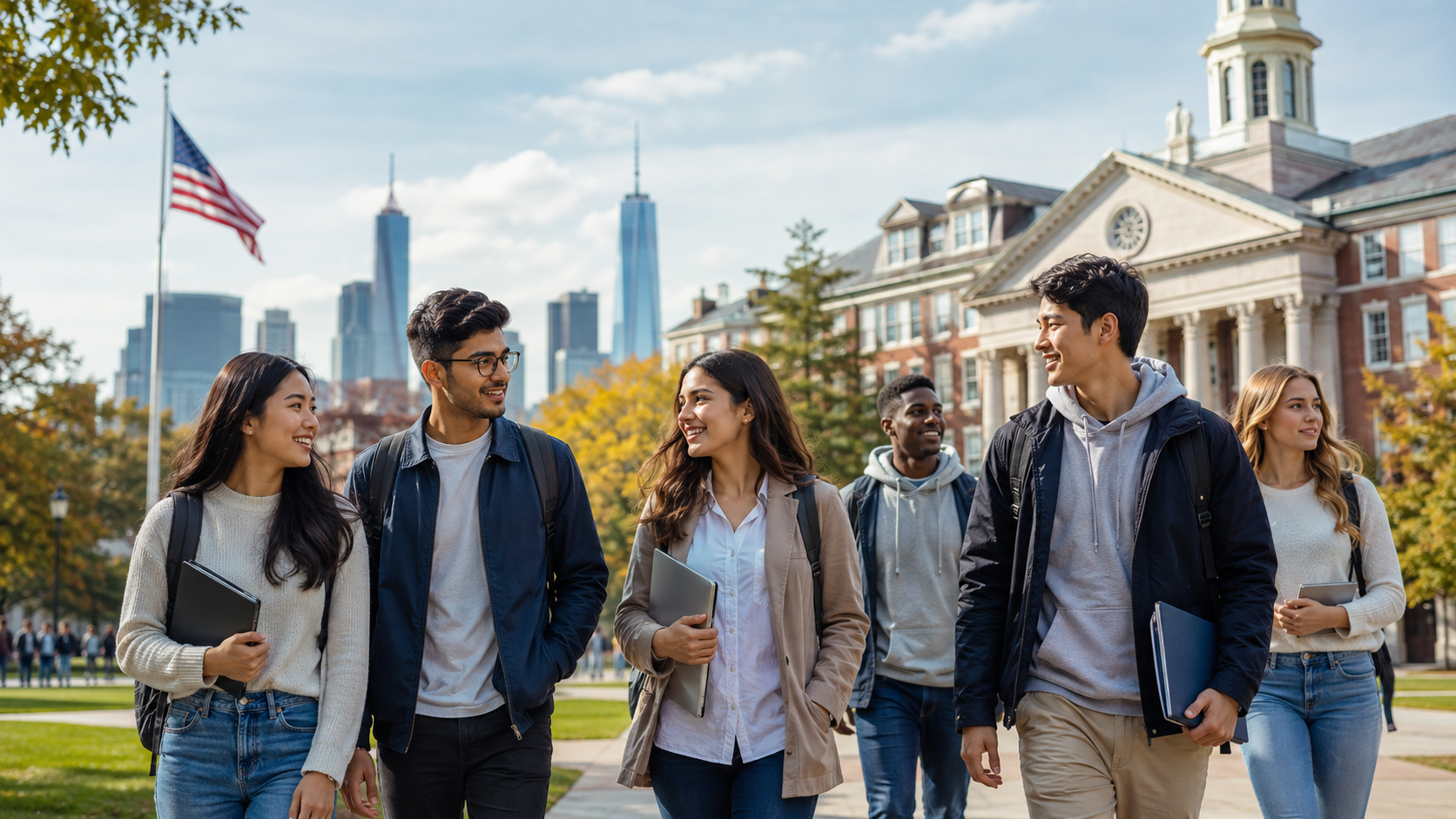
U.S. higher education in 2027: the numbers behind the market
The scale of American higher education is often described badly.
NCES counted 5,626 Title IV postsecondary institutions in the United States in 2024–25. That total included 1,869 public institutions, 1,674 private nonprofit institutions and 2,083 private for-profit institutions. But not all of those institutions were degree-granting colleges or universities. The more relevant degree-granting universe contained 3,802 institutions: 1,581 public, 1,577 private nonprofit and 644 private for-profit institutions. (National Center for Education Statistics)
That same NCES dataset recorded 2,349 institutions offering bachelor’s degrees, 1,918 offering master’s degrees and 834 offering research or scholarship doctorates. (National Center for Education Statistics)
International education sits inside that huge domestic system rather than operating as a separate market.
The Institute of International Education’s Open Doors 2025 report recorded 1,177,766 international students in 2024/25, up 5% year over year and equal to about 6% of the U.S. higher-education population. Graduate students numbered 488,481, undergraduates 357,231 and students participating in Optional Practical Training reached 294,253. (IIE)
The numbers immediately reveal a deeper shift.
Undergraduate international enrollment rose 4%. Graduate enrollment declined 3%. OPT participation surged 21%. And 57% of international students were studying in STEM fields. (IIE)
So the U.S. international-student market is not simply expanding. It is changing composition.
That matters for 2027 applicants because the strongest growth is increasingly connected to the intersection of education, science, technology and practical training.
| Indicator | Latest verified position |
| Title IV postsecondary institutions | 5,626 |
| Degree-granting Title IV institutions | 3,802 |
| International students | 1,177,766 |
| International undergraduates | 357,231 |
| International graduate students | 488,481 |
| Students on OPT | 294,253 |
| International students in STEM | 57% |
| F/M I-901 SEVIS fee | $350 |
| F/M student visa application fee | $185 |
The evidence years behind these figures remain 2024–25, 2024/25 or the current fee period. The 2027 in this guide is the planning cycle, not a licence to relabel older evidence as 2027 data.
Record international enrollment — but a weaker new-student pipeline
The headline number is powerful: 1.18 million international students.
The pipeline underneath it is more complicated.
Open Doors reported that new international student enrollment fell 7% to 277,118 in fall 2024. New undergraduate enrollment rose 5%, but new graduate enrollment fell 15%. (IIE)
Then came another warning signal.
Participating institutions in the Fall 2025 snapshot reported an overall 1% decline in international student totals, a 12% fall in graduate enrollment and a 17% decline in new international enrollment. Undergraduate enrollment, however, increased 2%, while OPT participation grew another 14%. (IIE)
Those figures do not contradict the record 2024/25 total. They measure different periods.
The full Open Doors report is retrospective. The Fall 2025 snapshot is an early indicator.
For 2027 applicants, the message is more useful than a simple “up” or “down” headline: the United States remains the world’s largest international higher-education destination, but demand, visa conditions and enrollment patterns are moving unevenly across study levels.
India became the largest country of origin with 363,019 students, up 10%, while China remained second with 265,919, down 4%. Twelve of the top 25 sending countries recorded their highest totals to date, including Bangladesh, Canada, Colombia, Ghana, India, Italy, Nepal, Nigeria, Pakistan, Peru, Spain and Vietnam. (IIE)
This is no longer a market defined only by China and India. International recruitment is broadening across South Asia, Africa, Latin America and Southeast Asia.
Why the United States still commands extraordinary academic power
Prestige explains only part of the U.S. advantage.
The deeper strength is the concentration of research money, laboratories, faculty, hospitals, technology companies, graduate schools and specialized academic ecosystems across hundreds of institutions.
MIT, Stanford and UC Berkeley sit at the center of global computing and engineering networks. Harvard, Johns Hopkins and major academic medical systems carry enormous weight in biomedical research. Chicago and Pennsylvania are deeply connected to economics, finance and business. Carnegie Mellon has become synonymous with computer science, artificial intelligence and robotics. Large public institutions such as Illinois, Michigan, Washington, Texas and California campuses operate research enterprises at a scale rivaling many national systems.
Yet concentrating only on famous universities produces a distorted view of American higher education.
The United States is not ten universities.
It is a layered system extending from highly selective research institutions to regional universities, specialist colleges and broad-access community colleges. Historical NCES evidence in the new U.S. research also shows that the number of Title IV institutions contracted substantially over the decade to 2020–21, with the private for-profit sector experiencing the sharpest decline.
That contraction points to a more competitive institutional environment. It also reinforces a basic rule for international students: institutional legitimacy, financial stability and academic outcomes deserve more attention than marketing.
Public university or private university? The label does not decide value
Public universities are the scale engine of American higher education.
They often combine enormous course catalogs, major research infrastructure, Division I athletics, international communities and broad graduate offerings. But international students generally do not benefit from the subsidized in-state tuition charged to residents.
The relevant public-university price is usually the nonresident or international price.
Private nonprofit universities work differently. State residency usually has no bearing on tuition, but financial aid can change the economics dramatically.
That creates one of the most important paradoxes in U.S. higher education:
The university with the higher sticker price can sometimes be the cheaper university.
A private institution charging more than $60,000 in tuition may have enough institutional financial aid to reduce the student’s actual cost substantially. A public university charging a lower published price may provide little or no need-based institutional aid to an international applicant.
The practical divide is therefore not simply public versus private.
It is net cost versus educational value.
Community colleges can change the financial equation
Community college is one of the most underused strategic routes into American higher education.
A typical two-year college offers associate degrees, certificates, technical education and transfer preparation. For students pursuing a bachelor’s degree, the familiar 2+2 model can mean completing approximately two years at a community college before transferring to a four-year institution.
The potential savings are significant.
College Board reported average published tuition and fees of $4,150 for public two-year in-district students in 2025–26, compared with $31,880 for public four-year out-of-state students and $45,000 at private nonprofit four-year institutions. International students may pay a higher rate than local in-district students, so $4,150 should not be treated as a universal international price. But the gap illustrates why community college deserves serious consideration. (College Board Research)
There is another reason not to dismiss the sector.
Open Doors reported that community colleges recorded the fastest international-student growth among institutional types in 2024/25, at 8%. (IIE)
The trade-off is transfer complexity.
A weak 2+2 plan can lose time and money if credits do not transfer, the target major has separate admissions requirements or the destination university does not guarantee entry. A strong plan starts with the four-year destination in mind and works backward.
The decision rule is simple: do not choose a community college first and investigate transfer later.
Accreditation is not paperwork — it is a quality-control decision
American higher education does not operate under one centralized government approval system.
The U.S. Department of Education does not itself accredit universities. Instead, recognized accrediting bodies evaluate institutions and, in some fields, individual academic programs.
That makes accreditation one of the earliest checks an international student should perform.
Institutional accreditation can affect credit transfer, graduate-school recognition, professional licensing and the credibility of the qualification. Programmatic accreditation can be crucial in fields such as engineering, business, nursing and other regulated or professionally structured disciplines.
The U.S. Department of Education’s DAPIP database and other recognized accreditation resources should therefore be part of the university-selection process.
A glossy website is not evidence of academic standing.
Neither is the ability to recruit internationally.
What can international students study in the United States?
Almost anything.
That breadth is part of the U.S. competitive advantage, but international demand is heavily concentrated.
Open Doors reported that 57% of international students were in STEM fields in 2024/25. (IIE) The existing U.S. evidence base identifies mathematics and computer science as the largest international field grouping, followed by engineering and business and management.
Computer science, artificial intelligence and data science
The United States remains one of the strongest global environments for computer science.
The advantage extends beyond university departments. Students in major technology regions operate near companies, research laboratories, venture-capital networks and startup ecosystems.
MIT and Harvard anchor the Greater Boston research economy. Stanford and Berkeley sit inside the Bay Area technology machine. Carnegie Mellon has exceptional depth in computer science, AI and robotics. Illinois has long-standing engineering and computing strength.
But the subject itself is becoming more specialized.
A student interested in machine learning should not assume that every strong computer science department provides equal depth in AI. Someone interested in cybersecurity, human-computer interaction, robotics, systems or data science needs a different comparison.
The question is not “Which university has computer science?”
It is “Which university is strongest in the part of computer science I actually intend to study?”
Engineering
Engineering remains another major international field.
The U.S. system offers broad routes across electrical, mechanical, civil, aerospace, chemical, biomedical, industrial and computer engineering.
Large public research universities can be particularly powerful because they combine laboratories, large faculties, industry partnerships and extensive postgraduate research.
Program-level accreditation can also matter. A university’s overall reputation should not substitute for checking the specific engineering program.
Business, finance and management
The American business-education market is unusually fragmented.
An undergraduate business degree, MBA, Master of Finance, Master of Management, Master of Business Analytics and PhD in Management are not interchangeable products.
A student targeting Wall Street may prioritize New York. An entrepreneurship-focused applicant may prefer a university connected to Silicon Valley or another startup ecosystem. Someone seeking quantitative finance requires a different curriculum from someone pursuing marketing or operations.
Rank the program against the career goal, not the institution against the world.
Medicine and health sciences
The U.S. medical pathway can surprise international students.
In most cases, the American MD is a graduate-entry professional degree. Students normally complete undergraduate education and prerequisite coursework before applying to medical school.
That makes “studying medicine in America” structurally different from direct-entry undergraduate medicine in many countries.
International eligibility at U.S. medical schools is also limited and institution-specific.
Students considering medicine should therefore treat pre-med, biomedical science, public health, nursing, health sciences and the MD as separate pathways.
Rankings matter — but they answer different questions
The United States dominates many global university rankings, but ranking systems measure different things.
QS, Times Higher Education, ARWU and U.S. News use different indicators, weightings and institutional universes. A university can therefore occupy very different positions across systems without anything being “wrong.”
This is where students often misuse rankings.
A research-heavy global ranking may be highly informative for a prospective PhD student. It may tell an undergraduate very little about financial aid, teaching environment, campus fit or the quality of a specific professional program.
EducationUSA itself emphasizes that there is no official national ranking system for U.S. colleges and universities. Its guidance focuses on matching institutions to the student’s academic, financial and personal needs.
University Intelligence therefore treats external rankings as evidence, not as a substitute for judgment.
A strong shortlist should consider ranking context alongside program depth, costs, aid, outcomes, location and the student’s actual goals.
Admissions are decentralized — and that changes strategy
There is no American equivalent of one national admissions rulebook.
Each university controls its own admission requirements.
That creates flexibility but also administrative complexity. Two universities in the same city can require different tests, essays, deadlines, financial forms and English-language evidence.
A typical undergraduate application may include academic transcripts, school reports, recommendations, essays, activities, standardized test results where required and proof of English proficiency where applicable.
Graduate admissions are even more program-specific.
A master’s program may require GRE or GMAT scores while another department at the same university does not. A PhD application may depend heavily on prior research and faculty fit. An arts program may require a portfolio. An MBA may expect professional experience.
Institution-specific requirements are not national rules.
That sentence should guide every U.S. application.
SAT and ACT: the testing landscape is moving again
The pandemic-era expansion of test-optional admissions changed U.S. undergraduate recruitment.
It did not create a permanent national standard.
Some institutions remain test-optional. Others have reinstated SAT or ACT requirements. Policies may vary by application cycle, applicant category or academic program.
For 2027 applicants, relying on a list published two years earlier is unsafe.
The right procedure is to check each university’s official admissions page for the exact entry cycle.
A test-optional institution may still consider scores if submitted. A test-required institution can reject an otherwise strong application if the applicant assumes the old policy remains in force.
Admissions strategy should therefore separate three questions:
Is the test required?
If optional, would a strong score improve the application?
If submitted, does the score strengthen or weaken the academic profile?
Those are different decisions.
English-language requirements are equally fragmented
TOEFL and IELTS remain widely used, while many institutions also accept Duolingo English Test or other assessments.
But there is no national minimum score.
Universities may waive English testing based on prior education, curriculum, country or language of instruction. Graduate schools may impose higher thresholds than undergraduate divisions. Professional programs can maintain separate standards.
The safe rule is straightforward: verify the program, not merely the university.
Start earlier than the deadline suggests
EducationUSA’s guidance recommends beginning U.S. university research approximately 12 to 18 months before the academic year of enrollment. (EducationUSA)
For fall 2027 entry, serious planning belongs in 2026.
That lead time is not excessive.
Students may need to research universities, sit standardized tests, obtain transcripts, secure recommendations, prepare essays, demonstrate English proficiency, pursue scholarships, compare financial packages and complete immigration steps after admission.
Waiting until the application deadline compresses all of those decisions into the same period.
Early preparation does something else: it improves choice.
The applicant has time to reject unaffordable universities before spending money on applications.
What does it really cost to study in the United States?
This is where U.S. higher education becomes difficult to summarize.
The price range is enormous.
College Board’s 2025–26 averages put published tuition and fees at:
| Institution type | Average published tuition and fees |
| Public two-year, in-district | $4,150 |
| Public four-year, in-state | $11,950 |
| Public four-year, out-of-state | $31,880 |
| Private nonprofit four-year | $45,000 |
International students considering public universities should pay particular attention to the out-of-state figure, because international students generally do not qualify for resident tuition merely by studying in the state.
Tuition, however, is only the first layer.
College Board estimated average 2025–26 undergraduate budgets of $50,920 for public four-year out-of-state students and $65,470 for private nonprofit four-year students. Those budgets incorporate tuition and fees, housing and food, books and supplies, transportation and other expenses. (College Board Research)
That is still only an average.
At individual private universities, total annual cost of attendance can move substantially above $80,000. In expensive metropolitan markets, housing becomes a major financial variable. Health insurance can add thousands more.
The correct comparison unit is therefore not tuition.
It is total annual cost of attendance after confirmed aid.
City choice can change the degree economics
A U.S. university cannot be separated from its location.
Boston, New York City, the San Francisco Bay Area and Los Angeles offer extraordinary academic and career ecosystems. They can also impose severe housing costs.
A student choosing New York gains proximity to global finance, media, technology, consulting, arts and healthcare. A student choosing the Bay Area gains access to perhaps the world’s densest technology and venture ecosystem. Boston offers an exceptional concentration of universities, biotechnology companies, hospitals and research institutes.
That opportunity has a price.
A comparable academic program in a lower-cost city can produce a very different total degree bill.
For international students, location is therefore a financial decision, not merely a lifestyle preference.
Boston and Cambridge: one academic ecosystem, different cities
Greater Boston illustrates why geographic precision matters.
MIT and Harvard are among the institutions that define the Boston academic ecosystem internationally.
Neither is located in the City of Boston.
Both are in Cambridge, Massachusetts.
Boston University and Northeastern University, by contrast, are in Boston proper.
That distinction may seem minor until housing, transport, municipal data and institutional geography are compared. University Intelligence’s Boston research deliberately separates Boston from Cambridge and the wider metropolitan ecosystem rather than repeating the common error of placing every Greater Boston university inside Boston.
This is the level of geographic accuracy international students need when comparing campus environments and living costs.
New York, Bay Area, Los Angeles, Chicago and other major student markets
The United States does not have one dominant education city.
It has several.
| Study destination | Major strengths |
| Boston / Greater Boston | Biotechnology, medicine, AI, engineering, research |
| New York City | Finance, business, media, arts, law, technology |
| San Francisco Bay Area | AI, technology, engineering, entrepreneurship |
| Los Angeles | Media, entertainment, business, engineering, healthcare |
| Chicago | Economics, finance, medicine, business, research |
| Washington, D.C. | Policy, government, law, international affairs |
| Philadelphia | Medicine, life sciences, business, engineering |
| Seattle | Technology, cloud computing, aerospace, biotechnology |
| Austin | Technology, semiconductors, engineering, startups |
A student’s academic and career interests should influence the city shortlist.
Someone targeting biotechnology may gain more from Boston than from an equally prestigious university in a weaker life-sciences cluster. A finance student may value New York. A computing student may prioritize the Bay Area, Boston, Pittsburgh, Seattle or Austin depending on specialization and budget.
Rankings do not capture that regional advantage well.
Sticker price can be misleading
American private universities are frequently described as prohibitively expensive.
Some are.
But the sticker price can obscure the financial-aid model.
Large private research universities with substantial endowments may devote significant resources to student aid. Your new U.S. research shows how concentrated institutional wealth has become, with the 2024 NACUBO-Commonfund study reporting $873.7 billion in combined endowment assets among participating institutions and a large majority of those assets concentrated among institutions with endowments above $1 billion.
That concentration creates very different institutional capabilities.
An elite private university may charge a very high published price while providing substantial grant aid to an admitted student. Another institution may discount tuition through merit scholarships. A third may expect international students to fund almost the entire cost themselves.
This is why published tuition alone is a weak affordability measure.
Scholarships for international students: substantial but uneven
The U.S. does not have one international scholarship system.
Funding is distributed across universities, departments, foundations, governments and exchange programs.
At undergraduate level, the main categories are institutional need-based financial aid and merit scholarships. Some institutions offer both. Others provide little assistance to international students.
Graduate funding works differently.
PhD programs may provide tuition support, research assistantships, teaching assistantships, fellowships and stipends. Master’s programs are more variable. Some are substantially funded; others operate primarily as tuition-funded professional degrees.
Programs such as the Fulbright Foreign Student Program add an external route, but eligibility and administration vary by country.
The crucial rule is this:
Never build a U.S. education budget around a scholarship that has not been awarded.
An expected scholarship is not money.
Need-blind financial aid: verify every university individually
Need-blind admissions for international undergraduates receives disproportionate attention because the policy can be extraordinarily valuable.
It is also easy to report incorrectly.
Institutions have changed their international financial-aid policies over time, which makes copied lists unreliable.
A university may be need-blind for domestic applicants but need-aware for international applicants. Another may be need-blind and also promise to meet full demonstrated need. Those are separate policies.
University Intelligence will therefore treat the definitive institution-by-institution cohort in the dedicated financial-aid guide rather than publishing an unstable headline count here.
For applicants, the rule is stronger than any list: read the current international financial-aid policy on the university’s own website before applying.
Can international students finance U.S. tuition through part-time work?
No responsible financial plan should assume that.
F-1 students do have lawful employment opportunities, but those rights are restricted.
The standard on-campus framework generally permits eligible F-1 students to work up to 20 hours per week while school is in session. Practical training categories such as CPT and OPT operate under separate rules.
Even where employment is lawful, part-time earnings are better viewed as support for some personal or living expenses—not as a dependable strategy for financing tens of thousands of dollars in annual tuition.
If the budget fails without future employment income, the budget is already weak.
F-1 student visa: admission is only the beginning
For most international students entering a U.S. university or college for academic study, the key immigration category is F-1.
The sequence begins with admission to an SEVP-approved school.
Once admitted and registered in SEVIS, the institution issues Form I-20. The student then pays the I-901 SEVIS fee, completes the DS-160 visa application and proceeds through the applicable U.S. Embassy or Consulate process. (Travel State)
The current visa application fee is $185. (Travel State)
The current I-901 SEVIS fee for F and M students is $350. (U.S. Immigration and Customs Enforcement)
Those are separate charges.
Visa issuance can also involve a nationality-specific issuance fee in some cases.
The State Department says new F and M student visas may be issued up to 365 days before the program start date, but new students cannot enter the United States more than 30 days before that date. (Travel State)
An admission letter is therefore not the end of the process.
It is the beginning of the immigration phase.
A major F-1 change is approaching the 2027 cycle
This is one of the most consequential policy developments for students planning 2027 study.
Historically, F-1 students have generally been admitted under Duration of Status, commonly shown as D/S. That framework allows a student who maintains status to remain through the authorized educational program and related practical training without a fixed immigration expiration date in the conventional sense.
DHS moved to change that system.
A final rule published in July 2026 replaces Duration of Status for F, J and I nonimmigrants with a fixed-period admission framework. DHS states that the admission period will be based on the program and generally capped at four years, with an extension-of-stay process for students who need additional time. (Federal Register Public Inspection)
For F-1 students, the final rule describes admission for the program period shown on Form I-20, up to the maximum authorized period, followed by a shorter departure or status-transition period under the new framework.
But timing matters.
The final rule is subject to congressional review, and its Federal Register notice specifies an effective-date mechanism rather than allowing us to pretend the rule has already governed every student since publication. (Federal Register Public Inspection)
For 2027 applicants, this development is too important to ignore and too volatile to oversimplify.
The controlling rule must be checked again before visa issuance, U.S. entry or any extension decision.
Working while studying: F-1 is not an open work visa
A student visa is primarily for study.
Employment is permitted only within authorized categories.
On-campus work is the most straightforward. CPT connects employment to the curriculum. OPT provides temporary practical training connected to the degree. STEM OPT can extend that opportunity for qualifying programs.
Each has different rules.
Confusing them can create immigration problems.
CPT: practical experience inside the academic program
Curricular Practical Training, or CPT, covers certain internships, cooperative education arrangements and other practical experiences that are integral to the curriculum.
CPT is authorized through the university’s Designated School Official within SEVIS rather than through the same EAD process used for standard OPT.
It can be part-time or full-time.
The major strategic warning is the 12-month full-time CPT threshold. Students who accumulate 12 months or more of full-time CPT at a degree level can lose eligibility for OPT at that level. (Study in the States)
That matters particularly at universities with extensive co-op programs.
Work experience is valuable.
But immigration arithmetic still applies.
OPT: up to 12 months of degree-related practical training
Optional Practical Training gives eligible F-1 students temporary employment authorization related directly to their field of study.
Standard OPT can provide up to 12 months. Pre-completion OPT uses part of the same overall allocation; post-completion OPT operates after the qualifying program ends. (Study in the States)
OPT is not a general employment visa.
The work must relate to the student’s major field.
Nor does OPT guarantee that an employer will hire the graduate.
The student still has to win the job.
STEM OPT: why STEM has become even more important
Eligible graduates in qualifying STEM fields may apply for a 24-month STEM OPT extension after standard post-completion OPT.
That can create up to 36 months of practical training across the original OPT period and the STEM extension. (Study in the States)
The employer must participate in E-Verify, and STEM OPT operates with additional training and reporting requirements, including Form I-983. (Study in the States)
This policy clearly increases the practical value of certain STEM degrees for international graduates.
But it should not control academic choice by itself.
A student with no interest or aptitude in engineering should not choose engineering because of immigration arithmetic. A degree is too expensive and too consequential for that.
OPT is not H-1B, and H-1B is not permanent residence
This distinction needs to be explicit.
F-1 is a student classification.
OPT and STEM OPT are forms of practical training connected to F-1 status.
H-1B is a separate temporary employment classification.
Permanent residence is another legal framework altogether.
A graduate can potentially move from F-1 practical training into employer-sponsored status where eligible, but none of those transitions is automatic.
A U.S. university degree does not guarantee H-1B selection.
It does not guarantee employer sponsorship.
It does not guarantee permanent residence.
Career planning and immigration planning overlap, but they are not the same thing.
Careers: the United States still offers extraordinary concentration
The strongest economic argument for American higher education is the density of advanced industries around major university regions.
Technology, AI, finance, consulting, engineering, biotechnology, healthcare, aerospace, media, advanced manufacturing and scientific research all operate at extraordinary scale.
International students can study close to some of the world’s most important employer clusters.
Boston connects universities to biotechnology, healthcare and research.
New York combines finance, consulting, technology, media, law and healthcare.
The Bay Area remains central to AI, software, venture capital and entrepreneurship.
Seattle combines cloud computing, technology and aerospace.
Los Angeles spans media, aerospace, business and health.
Chicago remains a major finance, consulting, research and healthcare market.
Austin has grown rapidly in technology, semiconductors and startups.
But geography creates access, not entitlement.
A Silicon Valley campus does not guarantee a Silicon Valley job.
Graduate outcomes deserve more attention than university advertising
A strong university decision should look beyond admissions.
Retention, graduation and graduate outcomes matter because they reveal what happens after enrollment.
Your new U.S. research draws on NCES data showing large differences in first-year retention and six-year completion across institutional sectors and levels of selectivity. Highly selective institutions report very strong continuation and completion rates, while open-access institutions face much lower outcomes.
Those differences should not be interpreted lazily.
Highly selective universities admit students with stronger prior academic preparation and often substantially greater institutional resources. Open-access institutions serve a broader population and frequently carry a different social mission.
But the outcome gap still has decision value.
International students paying full tuition should examine graduation rates, retention, academic support, career outcomes and program-level performance rather than assuming all accredited institutions provide equivalent results.
How to choose the right university for 2027
A strong U.S. shortlist should survive five tests.
Academic strength: Is the program genuinely strong in the intended subject and specialization?
Financial sustainability: Can the student fund the entire degree under a realistic exchange-rate and cost scenario?
Admissions probability: Is the list balanced rather than concentrated entirely in ultra-selective universities?
Career environment: Does the program provide credible access to research, internships, co-op, employers or professional networks?
Immigration fit: If practical training matters, does the academic program and student’s plan align with the relevant rules?
Prestige comes after those questions, not before them.
The most expensive mistake: choosing the name before the program
International applicants often begin with university brands.
That reverses the decision process.
A better sequence begins with the student’s subject, degree level, budget and career goals. Only then should institutions enter the comparison.
A student interested in AI may discover that one university with a lower overall global rank has a stronger specialist laboratory or research group.
A student targeting finance may value a university’s employer network more than its engineering reputation.
A student who needs aid may find that a very expensive private university is financially realistic while an apparently cheaper public institution is not.
A student hoping to transfer from community college needs articulation strength more than headline prestige in year one.
The program is the product. The university is the environment around it.
Both matter, but they are not interchangeable.
Is the United States worth it in 2027?
For the right student, yes.
Few countries can match the breadth of American academic choice, research infrastructure, graduate-school depth, interdisciplinary flexibility and proximity to major global industries.
But “worth it” depends on price.
A $90,000 annual budget and a $35,000 annual budget are not the same educational proposition even if both lead to respected U.S. degrees.
The strongest applicant evaluates return on education, not simply reputation.
That means examining what the student will learn, what access the university creates, how much the family will actually pay and what realistic options exist after graduation.
The United States remains exceptionally powerful.
It is not automatically exceptional value.
A 2027 decision framework for international students
The strongest application strategy is neither prestige-first nor immigration-first.
It is evidence-first.
Start with the academic goal. Establish the maximum sustainable budget. Identify accredited institutions with genuine program strength. Compare net cost rather than sticker price. Build a balanced admissions portfolio. Verify current testing requirements. Investigate scholarships before deadlines close. Examine city costs. Understand the F-1 framework. Then compare career and practical-training possibilities.
Do not reverse that order.
A student who starts with “I want Harvard” has a dream.
A student who starts with “I need a strong computer science program, a maximum annual family contribution of $35,000, credible aid, access to research and a realistic admissions portfolio” has a strategy.
The second approach is more likely to produce a good university decision.
Frequently asked questions about studying in the United States
How many universities and colleges are in the United States?
NCES reported 5,626 Title IV postsecondary institutions in 2024–25, including 3,802 degree-granting institutions. The larger number should not be described simply as 5,626 universities because it includes non-degree postsecondary providers. (National Center for Education Statistics)
How many international students are studying in the United States?
The latest complete Open Doors report recorded 1,177,766 international students in 2024/25, representing about 6% of U.S. higher education. (IIE)
Which country sends the most international students to the U.S.?
India was the largest source country in 2024/25 with 363,019 students, followed by China with 265,919. (IIE)
Are international student numbers still growing?
The full 2024/25 total increased 5%, but the Fall 2025 snapshot reported a 1% overall decline and a 17% fall in new international enrollment. The datasets refer to different periods. (IIE)
What are the most popular subjects for international students?
STEM fields accounted for 57% of international students in 2024/25, with mathematics/computer science and engineering especially important. (IIE)
How much does a U.S. university cost?
For 2025–26, College Board reported average published tuition and fees of $31,880 for public four-year out-of-state students and $45,000 for private nonprofit four-year students. Average total undergraduate budgets were higher: $50,920 and $65,470 respectively. Individual university prices can differ substantially. (College Board Research)
Are public universities always cheaper for international students?
No. Public universities can have lower sticker prices, but international students typically pay nonresident tuition and may receive less institutional need-based aid than at some wealthy private universities.
Can international students start at a community college?
Yes, where the college is authorized for the student’s status and the academic pathway fits. Community college can support a lower-cost transfer strategy, but transfer agreements and credit recognition must be checked before enrollment.
Do all U.S. universities require SAT or ACT scores?
No. Requirements are institution-specific and continue to change. Applicants for 2027 should verify the exact policy for every university.
Is there an official U.S. university ranking?
No single federal or official national ranking determines the best U.S. universities. Different ranking organizations use different methodologies.
How early should international students begin?
EducationUSA recommends beginning research about 12 to 18 months before enrollment. (EducationUSA)
What is the current F-1 visa application fee?
The U.S. Department of State lists the student visa application fee at $185. (Travel State)
What is the current SEVIS I-901 fee?
The current F/M student I-901 SEVIS fee is $350. (U.S. Immigration and Customs Enforcement)
Can F-1 students work while studying?
Yes, within permitted categories and conditions. On-campus employment, CPT, OPT and STEM OPT operate under different rules. F-1 status does not create unrestricted work authorization.
How long can OPT last?
Standard OPT can provide up to 12 months. Qualifying STEM graduates may seek a 24-month STEM extension, potentially creating up to 36 months of practical training. (Study in the States)
Does a U.S. degree guarantee a job or immigration pathway?
No. Admission, graduation, OPT, employment, H-1B and permanent residence are separate stages governed by different academic, employer and immigration decisions.
The University Intelligence view
The United States remains a heavyweight of global higher education because few systems can match its combination of academic range, research scale, institutional diversity and employer ecosystems.
But scale creates noise.
Thousands of institutions, changing admissions policies, radically different financial-aid models, volatile immigration rules and enormous regional cost differences can turn a famous destination into a poor individual decision.
That is why the strongest 2027 applicant will not ask only:
Which U.S. university is best?
The better questions are harder:
Which program is best for my field?
What will I actually pay after confirmed financial aid?
Can that budget survive for the full degree?
What academic and career outcomes does the program produce?
What does the city add—or cost?
What immigration rules apply to my study and practical-training plan?
Answer those questions first.
The rankings can come later.
The United States offers extraordinary educational power. The advantage belongs to students who know how to choose within it.

